
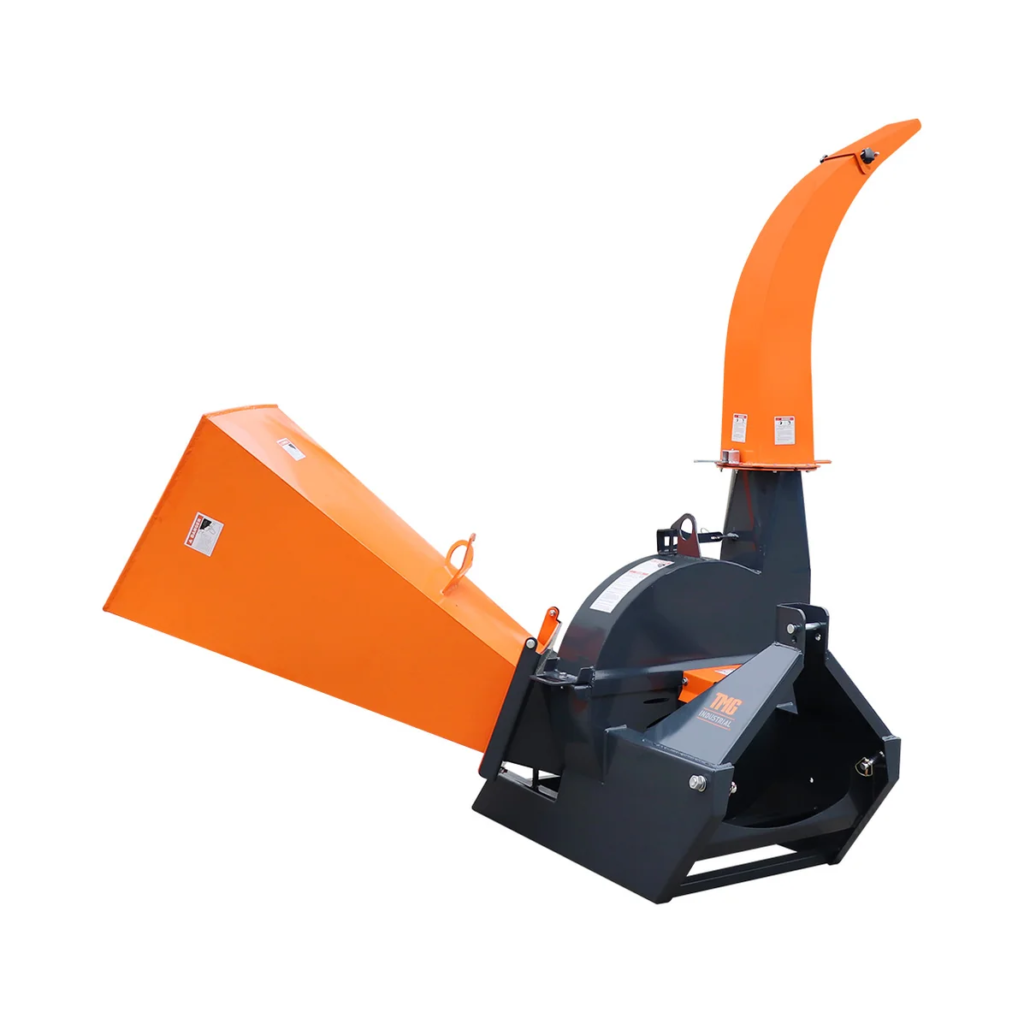
By the middle of a Canadian summer, storm cleanup, thinned windbreaks, and pruned orchard limbs pile up faster than any burn pile can handle. Landowners with a tractor already on hand look for a way to reduce that brush to chips they can spread as mulch or haul off in a single load.
That search leads many of them to a power takeoff wood chipper, and the sense of the machine starts with how it borrows the tractor engine rather than carrying a motor of its own.
Borrowed Engine Power Arrives Through a Single Splined Shaft
A power takeoff wood chipper has no engine. It draws everything it needs from the tractor through the power takeoff shaft at the rear, a splined stub that turns at five hundred forty revolutions per minute on most compact and utility tractors.
That speed is a standard, and the chipper is built around it. The gearbox and drive belts inside are geared so the cutting rotor reaches its working speed exactly when the shaft spins at that rated figure.
Running the tractor faster does not help and is dangerous because the whole machine is tuned to that one input speed. Matching engine revolutions to the rated setting is the first habit a careful operator forms.
- Splined shaft: transmits torque at a fixed speed
- Rated speed: five hundred forty revolutions per minute
- Shielded driveline: covers the spinning shaft completely
- Matched gearing: sets rotor speed from engine input
Powered Rollers Decide How the Machine Eats
The feed rollers are what let a power takeoff wood chipper handle limbs safely. Larger branches do not simply fall into the cutting rotor; a set of powered rollers grips each limb and draws it in at a controlled rate.
This matters because the rotor can only remove so much wood per turn. If material arrived faster than that, it would stall the driveline, so the rollers meter the feed to keep torque demand within what the shaft can deliver.
The rollers also protect the operator since limbs are pulled from the hand rather than requiring a shove. Standing to the side of the feed opening, never in line with it, is the rule that keeps the powered intake an ally instead of a risk.
Where the Chips Go is a Design Choice, Not an Afterthought
Once wood passes the rotor, it becomes a fast stream of chips that has to leave the machine cleanly. A discharge chute lifts that stream up and away, and a rotating hood lets the operator aim it into a trailer or across a field.
Aiming matters more than it seems. Point the chute into the wind and the chips scatter back over the tractor; turn it downwind and they land where they are wanted, building an even mulch layer instead of a drifting mess.
A clogged chute kills productivity, so the interior surfaces are kept smooth and the airflow off the rotor is used to help carry chips out and keep the flow moving.
- Discharge chute: lifts chips clear of the machine
- Rotating hood: aims the stream on demand
- Smooth interior: resists clogging under load
- Rotor airflow: helps push chips outward
Understood as a system, a power takeoff wood chipper works as one chain: a borrowed engine, a metered feed, and a directed discharge in sequence. Each stage lets a tractor already in the yard turn a summer of storm debris into something useful.
For Canadian landowners, that is what makes a power takeoff wood chipper less an added expense than a way to finish the season with the equipment already parked in the shed.