
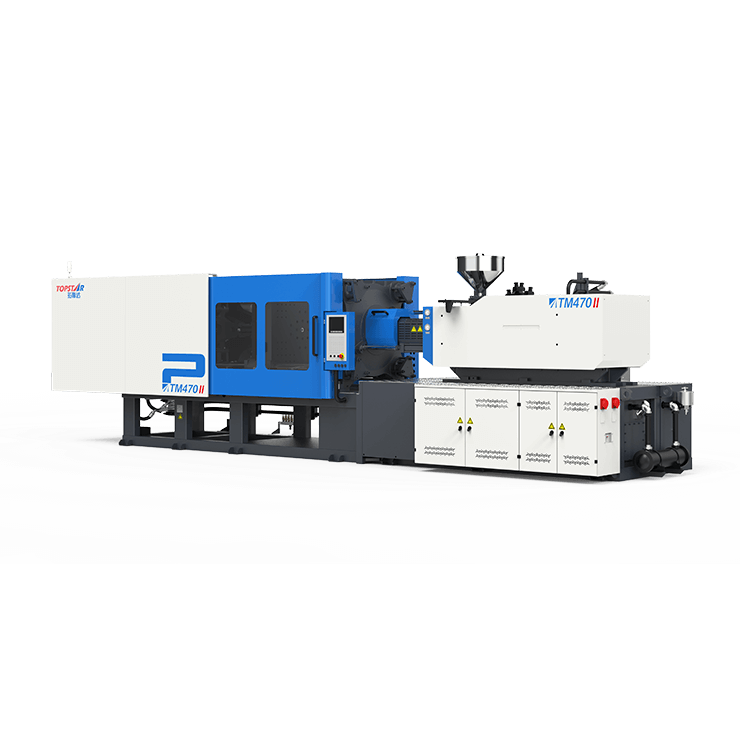
Part ejection is a critical stage in the injection molding cycle; even minor improvements in the ejection mechanism can significantly reduce defects, shorten cycle times, and boost overall production efficiency. As a leading manufacturer of mold temperature controllers and injection molding equipment, Topstar has successfully increased ejection force by 20%, thereby significantly enhancing the machine’s demolding capabilities. This technological advancement empowers manufacturers to handle complex geometries, precision components, and high-volume production demands with greater confidence and efficiency.
The Key Role of Ejection Force in the Demolding Performance of Injection Molding Machine
The importance of ejection force to a machine’s demolding performance cannot be overstated. Sufficient and stable ejection force ensures smooth part release, preventing deformation, mold sticking, or damage. Insufficient force often leads to production delays, higher scrap rates, and increased maintenance requirements for both the mold and the plastic injection molding machine.
By boosting ejection force by 20%, Topstar provides the power needed for reliable release of complex or deep-cavity parts, effectively resolving the aforementioned challenges. While delivering robust ejection capabilities, the machine maintains smooth, controlled movement to protect the part’s intricate structure. Our engineering team optimized the ejection system to achieve high performance without compromising the machine’s overall stability or energy efficiency.
Engineering Innovations Behind the Increased Ejection Force in Injection Molding Machine
The increase in ejection force results from engineering innovations that integrate precision mechanical design with intelligent control systems. Topstar utilizes reinforced ejection plates, high-strength guide pillars, and optimized hydraulic or servo-driven systems to deliver extra thrust while ensuring smooth operation. The design distributes loads evenly, preventing localized stress concentrations that could otherwise compromise long-term reliability.
Advanced control algorithms complement mechanical improvements, ensuring precise ejection force is applied at the exact moment required during the production cycle. This plastic injection molding machine achieves a 20% increase in thrust without the need for a higher-power motor or any sacrifice in energy efficiency. Testing confirms that the system maintains exceptional repeatability across thousands of operating cycles.
Impact of Molding Machine on Part Quality and Surface Finish
Using a molding machine with enhanced ejection force yields immediate, positive effects on part quality and surface finish. Topstar machines apply force more evenly and with greater control, mitigating risks such as part deformation, ejector pin marks, or stress whitening—issues often caused by insufficient or unstable ejection force. This results in smoother demolding and a superior surface appearance.
Manufacturers obtain finished parts with improved dimensional stability and lower internal stress. The machine maintains these quality advantages regardless of the material or part geometry. Enhanced ejection capabilities also enable smaller draft angles and more complex designs—features that are often difficult to achieve with standard ejection systems.
Cycle Time Reduction and Productivity Enhancement in Injection Molding Machine Operation
Cycle time reductions and productivity gains occur naturally when a plastic injection molding machine is equipped with enhanced ejection force. Topstar’s design enables faster, more robust mold opening and part ejection, shortening overall cycle time without compromising product quality. Reliable ejection performance allows for more aggressive process parameter settings while maintaining process stability.
Manufacturers can achieve higher output with existing equipment, thereby improving return on investment (ROI) and overall equipment effectiveness (OEE). Injection molding machine with optimized ejection performance reduce reliance on conservative settings and avoid unnecessary cycle extensions. These efficiency gains accumulate over time, ultimately leading to significant increases in production volume.
Advantages of Enhanced Ejection Systems: Energy Efficiency and Service Life
Enhanced ejection force provides Topstar molding machines with significant advantages regarding energy efficiency and system longevity. The optimized design ensures more efficient power transmission, lowering overall energy consumption during the ejection phase. Precise control minimizes unnecessary movement and mechanical stress, extending maintenance intervals and reducing maintenance costs.
These machines deliver superior ejection performance alongside these energy efficiency improvements. Consequently, manufacturers benefit from lower energy costs and more manageable maintenance schedules. Furthermore, the robust structural design of the enhanced ejection system helps extend the overall service life of the machine.
Case Study: Practical Applications of Increased Ejection Force
Real-world examples clearly demonstrate the practical value derived from increasing the ejection force of injection molding machines. Topstar has documented numerous successful applications where a 20% increase in ejection force not only resolved specific demolding challenges but also delivered quantifiable operational benefits. These cases provide compelling evidence of the technology’s effectiveness across various application scenarios and industries. Manufacturers consistently report that upgrading their equipment improves product quality, reduces scrap rates, and enhances production efficiency. Injection molding machines with optimized ejection performance offer significant value, particularly for the production of complex parts and in high-volume manufacturing environments.