
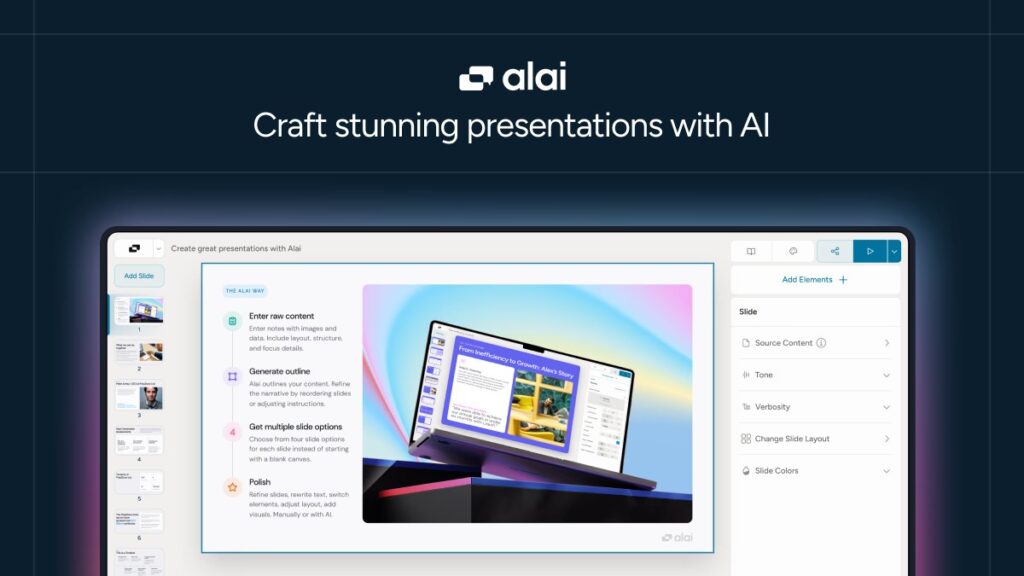
Introduction: Why AI Pitch Decks Feel Like a Shortcut—Until They Aren’t
For startup founders, time is always the enemy.
When fundraising starts, everything feels urgent. Investor meetings stack up. Feedback comes fast. Decks need constant updates. So when AI pitch deck tools promise a complete presentation in minutes, it feels like a relief.
You paste your notes. You click generate.
And suddenly, you have a deck.
At first glance, it looks fine.
- The slides are there
- The structure makes sense
- Nothing looks obviously broken
For many founders, this is where confidence kicks in. “Great, the deck is done.”
But that confidence rarely survives the first real investor meeting.
Slides that looked acceptable on your screen start falling apart when someone else looks at them. Important points don’t stand out. You find yourself talking more than you should, explaining what the slide is supposed to mean. Instead of supporting your story, the deck starts slowing it down.
This isn’t because AI pitch deck tools are useless. It’s because most of them solve only part of the real problem.
They get you most of the way there—but they stop short of what actually convinces investors.
That missing part is what many founders experience as frustration. It’s subtle, hard to define, and incredibly important. It’s the last 20%, and it’s where pitch decks either work or quietly fail.
The 80% Trap Most Founders Don’t Notice at First
Most AI pitch deck generators are built around speed. Their goal is simple: turn raw input into slides as fast as possible.
From a technical perspective, they do that well. In minutes, you can go from nothing to a full deck. But speed alone doesn’t make a deck effective.
This is where the 80% trap appears.
At 80% completion:
- The deck looks finished
- The story feels coherent
- The slides are filled
But at this stage, the deck is only structurally complete. It’s not investor-ready.
The difference matters more than founders expect.
Having a pitch deck means you have slides.
Having an investor-ready pitch deck means those slides:
- guide attention
- highlight what matters
- make complex ideas easy to grasp
- and reduce the need for verbal explanation
Most AI tools stop at assembling content. They don’t make judgment calls about emphasis, hierarchy, or visual clarity. And those judgment calls are exactly what investors react to, often without saying so explicitly.
That’s why the problem usually shows up late. Not when the deck is generated. Not when it’s reviewed internally. But when it’s used in real conversations with real investors.
Suddenly, founders realize:
- Slides don’t support the narrative
- Key moments don’t feel strong
- The deck doesn’t “carry” the pitch
The tool delivered a deck, but not a convincing one.
Why the Last 20% Is Where Most AI Pitch Decks Break
The final 20% of a pitch deck isn’t about adding more information. It’s about shaping how information is perceived.
This part is difficult because it combines multiple challenges at once, and most AI tools aren’t designed to handle them together.
- Layouts that don’t match the purpose of the slide
A traction slide and a competition slide should not look the same. Yet many AI-generated decks rely on identical layouts, forcing very different ideas into the same visual structure. - Templates that erase brand identity
Investors see patterns quickly. When a deck looks like dozens they’ve already seen, it quietly signals a lack of differentiation, even if the business itself is strong. - Complex concepts reduced to text
Market dynamics, positioning, and go-to-market strategy are visual problems. When they’re presented as paragraphs or bullet lists, clarity is lost and attention drops. - One-shot generation that doesn’t support iteration
Fundraising is not a single pitch. It’s a cycle of pitching, receiving feedback, refining, and pitching again. Decks need to evolve quickly without being rebuilt from scratch each time. - Manual fixes that destroy speed
Once founders start exporting decks and adjusting layouts manually, they lose consistency and momentum. The promise of speed disappears, replaced by small but exhausting design decisions.
The last 20% is painful because it requires context and judgment. It’s where storytelling meets design, and where clarity matters more than volume.
This is also why founders often feel stuck. The deck is almost there, but “almost” isn’t enough when investors are deciding what to remember, what to question, and what to ignore.

The Slides That Actually Decide Investor Interest
Most founders think investors evaluate pitch decks slide by slide. In reality, investors filter much faster.
They skim first.
They pause only on slides that signal clarity, momentum, or risk.
And they mentally weigh just 10–15 core slides when deciding whether a startup is worth deeper attention.
These usually include:
- Problem
- Solution
- Market Size
- Product
- Traction
- Business Model
- Competition
- Team
- The Ask
What many AI pitch deck generators miss is that each of these slides serves a different purpose. Treating them the same visually weakens the entire deck.
For example:
- A problem slide should be sharp and minimal, framing urgency
- A traction slide should instantly show growth and direction
- A competition slide should communicate positioning, not just names
- A market slide should simplify scale, not overwhelm with numbers
Generic AI tools flatten these differences. They apply one layout logic across every slide, which forces very different ideas into the same visual container. The result is a deck that technically includes the right slides, but doesn’t communicate their importance correctly.
Investors don’t just ask what your slides say. They respond to how easily those slides answer their questions.
If you want a clear reference for how these core slides are typically structured and evaluated, this complete guide to creating an investor pitch deck breaks down expectations in a way that aligns with real fundraising conversations:
The key takeaway here is simple:
A strong pitch deck isn’t about having all the slides. It’s about making each slide do its specific job well.
What “Investor-Ready” Actually Means in Practice
Founders often describe decks as “polished” or “clean,” but investors use a different mental checklist.
To an investor, “investor-ready” doesn’t mean flashy. It means clear, intentional, and trustworthy.
An investor-ready deck:
- communicates ideas, instead of just storing information
- uses visual hierarchy to guide attention
- feels consistent from start to finish
- avoids looking like a webpage, document, or Notion page
The difference between a slide that contains information and one that communicates information is subtle but critical. Communication requires decisions:
- What should stand out first?
- What can be secondary?
- What can be removed entirely?
Visual hierarchy does that work silently. Spacing, alignment, and emphasis guide the eye without explanation. When hierarchy is missing, investors feel cognitive friction, even if they can’t articulate why.
Consistency plays a similar role. When fonts, spacing, and layout rules stay predictable across the deck, investors subconsciously trust the team behind it. Inconsistency suggests chaos, even when the business itself is solid.
Another common mistake is treating pitch decks like content-heavy documents. Investors don’t want to read. They want to understand quickly. Dense slides slow momentum and force founders to over-explain.
Looking at real pitch deck examples from funded startups makes this distinction obvious. Many successful decks are surprisingly simple, because simplicity supports clarity. You can see this pattern clearly in this curated collection of real-world pitch deck examples.
Investor-ready doesn’t mean perfect design. It means the deck helps the investor follow the story without effort.
Why Most AI Pitch Deck Tools Fail at Iteration
Fundraising is rarely won with the first version of a pitch deck.
More often, it looks like this:
- Pitch the deck
- Get feedback
- Adjust messaging
- Update slides
- Pitch again
This loop repeats many times, often under tight timelines. The problem is that most AI pitch deck tools are designed for generation, not iteration.
They work well when you’re starting from nothing. They struggle once feedback enters the picture.
Common issues founders run into:
- Small content changes break slide layouts
- Adjusting one slide creates inconsistency across others
- New insights require reworking multiple slides manually
- Exported decks lose the benefits of AI assistance
At this stage, founders are usually back in PowerPoint or Google Slides, making incremental fixes that feel minor but add up quickly. Each version takes longer. Each iteration increases friction. The speed advantage disappears.
This is where many founders feel the disconnect:
- The tool helped them get started
- But it didn’t help them finish strong
Iteration is not a secondary feature in fundraising. It’s the core workflow. Tools that don’t support fast, high-quality iteration force founders to choose between speed and quality, and that’s a choice no fundraising team wants to make.
Understanding this limitation sets the stage for the real question:
How do you close the last 20% gap without sacrificing speed?
That’s where the right approach, and the right tool, starts to matter.
Closing the Last 20% Gap with Alai
Closing the last 20% of a pitch deck doesn’t require more content. It requires better control, over layout, context, and iteration.
This is where Alai is designed differently from generic AI pitch deck generators.
Instead of treating slides as isolated outputs, Alai treats the pitch deck as a connected system. That difference matters once founders move past first drafts and into real fundraising cycles.
Here’s how that gap gets closed in practice:
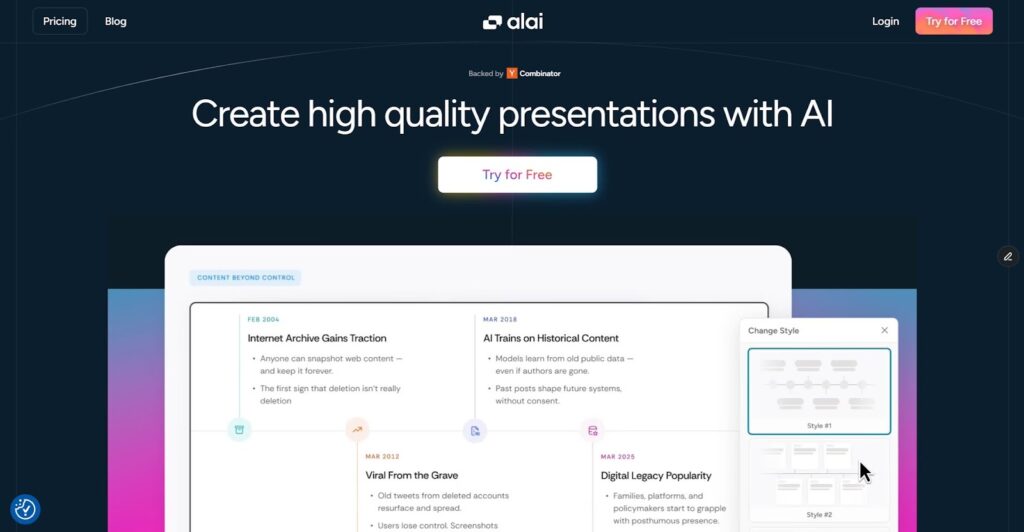
- Multiple layout options per slide
Instead of forcing a single structure, Alai provides multiple layout options for each slide. Founders can choose the layout that best matches the intent of the content—whether it’s traction, competition, or market sizing. - Context-aware editing across the entire deck
Changes aren’t made in isolation. Edits take into account the full deck, acronyms, terminology, narrative flow, so consistency is preserved as the deck evolves. - A responsive canvas that adapts to change
When content updates, layouts respond intelligently. Text expansion, metric changes, and visual adjustments don’t break the slide structure or spacing. - Shared control over spacing and alignment
Both AI and users can control spacing intentionally. This enables cleaner hierarchy and design decisions that typically require manual design work. - Brand themes that lock in identity
Fonts, colors, and layout rules stay consistent across iterations, preventing the “template drift” that often happens when decks are rebuilt repeatedly. - Natural-language iteration through slide chat
Founders can request changes in plain language—such as making a slide more visual or simplifying a message—and review options before committing.
If you’re comparing which tools actually support investor-ready output, not just fast generation, this breakdown of the top AI pitch deck generators explains where real differences show up during iteration.
A Repeatable Workflow for Founders Raising Capital
The goal isn’t to create a perfect deck once. It’s to move through fundraising cycles efficiently without losing quality.
A practical, repeatable workflow looks like this:
- Start with raw notes or a simple outline
Focus on clarity, not polish. The goal is to capture the narrative quickly. - Generate structured slides with appropriate layouts
Choose layouts that match the purpose of each slide instead of forcing uniformity. - Iterate immediately after investor feedback
Adjust messaging, visuals, or emphasis while the conversation is still fresh. - Maintain consistency across versions
Ensure spacing, hierarchy, and branding remain intact as slides change. - Prepare the next version before the next meeting
Speed matters—but only when quality stays high.
This approach allows founders to respond to investor input without rebuilding decks from scratch or sacrificing clarity along the way.
Stop Settling for 80%
Most founders don’t lose deals because their ideas are weak. They lose deals because their decks don’t communicate those ideas clearly under pressure.
AI pitch deck tools that stop at 80% create the illusion of readiness. But investor decisions are shaped by the final 20%, the part where clarity, structure, and iteration speed matter most.
If you’re done settling for “good enough” slides and want a deck that actually supports your fundraising conversations, it’s worth raising the standard.
Explore how Alai helps founders move from generated decks to investor-ready presentations at Alai.
And if you want a broader comparison of tools built specifically for pitch decks, this guide to the best AI presentation tools for pitch decks provides additional context.
Final Thoughts
AI has changed how quickly pitch decks can be created, but speed alone doesn’t win investor confidence.
The founders who raise successfully are the ones who iterate well. They refine their message, improve clarity, and adapt quickly to feedback without losing momentum.
The last 20% of a pitch deck isn’t about perfection. It’s about communication. Tools that support thoughtful iteration, visual clarity, and consistency give founders a real advantage, not just in how fast they move, but in how clearly they’re understood.
FAQs
1. Why do AI-generated pitch decks often feel generic?
Because most tools rely on uniform templates and treat every slide the same, regardless of its purpose or audience.
2. Can AI fully replace manual pitch deck design?
AI can accelerate creation and iteration, but investor-ready decks still require judgment around clarity, hierarchy, and emphasis.
3. What makes a pitch deck truly investor-ready?
Clear messaging, strong visual hierarchy, consistent design, and slides that communicate ideas quickly without explanation.
4. How many slides should an AI-generated pitch deck include?
Most effective investor decks fall between 10 and 15 slides, focusing only on what drives investor decisions.
5. How should founders iterate pitch decks during fundraising?
By updating decks quickly after feedback, maintaining consistency, and focusing on clarity rather than adding more content.