
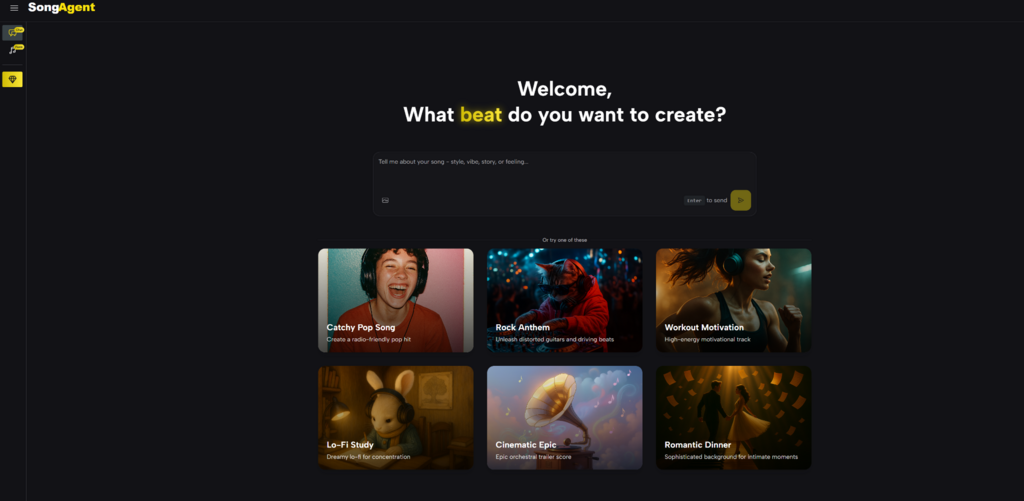
The modern digital landscape is voracious, consuming audio-visual content at a rate that traditional production methods cannot sustain. For game developers, podcasters, and YouTube creators, the bottleneck is rarely the video or the script—it is the music. Finding cohesive, copyright-safe audio that fits specific durational needs is a logistical nightmare. The AI Song Agent offers a solution not by writing better songs, but by reimagining music as a scalable asset. This approach moves beyond the “one-off” song creation model to a “batch production” capability, effectively functioning as an on-demand factory for bespoke audio assets.
The Economics Of Volume In Media Production
A video game does not need one theme song; it needs hours of background ambience, battle music, and menu loops. A podcast series needs consistent branding across dozens of episodes, not a new genre every week. Traditional stock music libraries fail here because their tracks are static—you cannot ask a stock library to “make this track 30 seconds longer” or “remove the drums.” An agentic system, however, can generate infinite variations on a theme, solving the volume problem without sacrificing thematic consistency.
Consistency Across High Volume Outputs
The critical feature for scale is “Batch Creation.” This allows a user to define a “sonic brand”—for instance, “Cyberpunk Industrial”—and instruct the agent to generate ten distinct tracks that share that DNA. This ensures that while every piece of music is unique (avoiding listener fatigue), they all feel like they belong to the same project. This level of coherence is typically only available by hiring a human composer for weeks of work.
Navigating The Copyright Minefield
For commercial entities, the provenance of an asset is as important as its quality. Using generative tools often introduces legal ambiguity regarding ownership. By explicitly designing the output to be royalty-free and commercially viable, the platform removes the risk of copyright strikes. This effectively allows a small indie developer to own their entire soundtrack, an asset class that was previously rented from licensing platforms.
Evaluating Asset Ownership Models
The shift from licensing to generation fundamentally changes the economic equation for creators.
| Economic Factor | Traditional Stock Licensing | Batch Agent Generation |
| Cost Basis | Per Track / Per Use | Flat Subscription / Credits |
| Exclusivity | Non-Exclusive (Others use it) | Unique (Generated for you) |
| Volume Cap | Limited by library size | Unlimited generation |
| Cohesion | Mixed (Different composers) | Uniform (Same AI parameters) |
| Rights | Leased (Usage restrictions) | Owned (Commercial rights) |
Implementing A Mass Production Workflow
The process for creating bulk assets differs significantly from writing a single pop song. It focuses on efficiency and uniformity.
Step 1: Defining The Sonic Palette
The user establishes the core parameters for the project. For example, “Background music for a fantasy RPG, focusing on orchestral strings and woodwinds, with a mysterious mood.” This sets the constraints for the entire batch.
Step 2: Executing Parallel Composition
Instead of generating one track, the user initiates a batch request. The agent processes the prompt to create multiple unique compositions simultaneously. Each track adheres to the “fantasy RPG” constraint but varies in melody and arrangement to provide diversity.
Step 3: Strategic Selection And Deployment
The user reviews the generated batch. Suitable tracks are downloaded immediately for integration into the game engine or video editor. Unsuitable tracks are discarded or regenerated, optimizing the time-to-asset ratio.
From Art To Infrastructure
Viewing music as infrastructure rather than art may seem utilitarian, but it is necessary for the current speed of content creation. By automating the production of functional background audio, creators can allocate their limited budget and attention to the “hero” elements of their projects. This technology provides the foundation upon which digital experiences are built, ensuring that the visual components are never let down by a lack of auditory depth.