
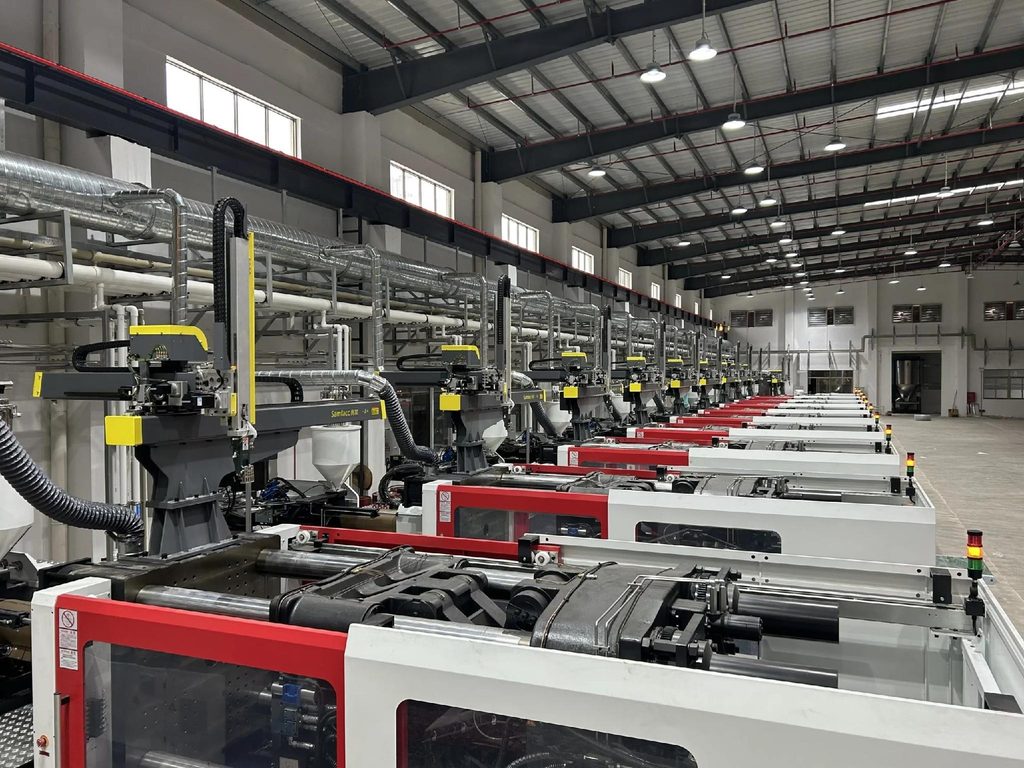
Buying an in mould labelling machine is one of those decisions that looks simple in a brochure and gets complicated on the factory floor. The right unit drops pre-printed labels into the mould so the graphic fuses with the container wall — no glue, no peeling, no second operation. The wrong one fights your container shapes, jams on your label stock, or sits idle while you wait for spare parts. These five decisions, in this order, are what separate a good purchase from an expensive lesson when you choose an in mould labelling machine.
Start With Your Container, Not the Catalogue
Catalogues list impressive specifications, but the only one that matters first is your container. An in mould labelling machine must place labels accurately inside a mould built for your exact tub, lid, bucket or bottle — wall curvature, draft angles and rim shape all decide which arm, gripper and placement method will work. A round yoghurt tub is forgiving; a rectangular tub with tight corners or a bottle with compound curves needs precise positioning and often static-assisted placement. Bring your actual container drawings to the supplier and insist on a trial with your real label artwork before signing anything. An in mould labelling machine that runs beautifully on the supplier’s demo tub may struggle with yours, and that discovery is far cheaper in their factory than in yours. Finally, confirm the mould interface: some units work with any injection moulding machine, others need specific ejector or core-pull signals, and retrofitting later costs real money.
Match Label Material to the Machine’s Handling
Labels for in-mould work are usually polypropylene film, but thickness, stiffness and static behaviour vary between suppliers. Your in mould labelling machine must handle the exact stock you plan to buy — the pick method that works for a stiff 60-micron film can double-pick a flimsy 40-micron one. Ask the supplier to run your label stock, not their house stock, during the trial, and watch for consistent single picks across a full magazine. Static control matters as well: labels build charge in dry air and cling together, so check that the ionisers or static-assist tooling are sized for your climate, not just the supplier’s test lab. If you might switch label vendors later, confirm the in mould labelling machine can be retuned for different stock without a paid service visit.
Size the Throughput and Automation Level Honestly
Throughput is where buyers most often overspend or underspend. An in mould labelling machine is rated in cycles per hour, but your real number is the mould’s cooling time — the unit must finish pick-and-place inside that window. If your mould cools in six seconds, a robot rated for four-second cycles gives you margin; one rated for six gives you anxiety. Automation level is the next fork: a basic side-entry robot suits a single mould running one product, while a top-entry or multi-axis in mould labelling machine with automatic magazine loading suits a high-mix plant. Be honest about staffing as well — a fully automated cell with conveyors and stackers costs more upfront but pays back where labour is scarce or turnover is high. Buy for the production plan you have signed, not the one you hope to have.
Check Changeover and Line Flexibility
If you run more than one SKU, changeover time decides your real output. Ask how long it takes to switch an in mould labelling machine from one container to another: gripper change, magazine swap, program recall. The best setups store programs per SKU and complete the mechanical swap in under thirty minutes. Check whether grippers and magazines are shared across your container family or unique to each SKU — unique tooling multiplies the spares on your shelf. Look beyond the machine too: does it discharge to a conveyor, a stacker or a packing table, and can that downstream equipment keep up with your fastest container? Judge the in mould labelling machine as part of the cell, not as a standalone box, because it is only as flexible as the line it feeds.
Judge the Supplier, Not Just the Machine
The machine will outlast the sales conversation, so evaluate what comes after installation:
- Spare parts: are vacuum cups, grippers and valves standard items or custom-machined?
- Service response: what is the guaranteed response time, and is there a technician within driving distance?
- Training: does the supplier train your operators and maintenance crew, or just hand over a manual?
- References: ask for two customers running your container type, and actually call them.
When you compare quotes, normalise them first — same throughput, same automation level, same warranty — then compare the supplier standing behind each in mould labelling machine. Price matters, but the cheapest machine with the weakest support is the most expensive one you can buy: every hour of unplanned downtime costs more than the discount you saved.