
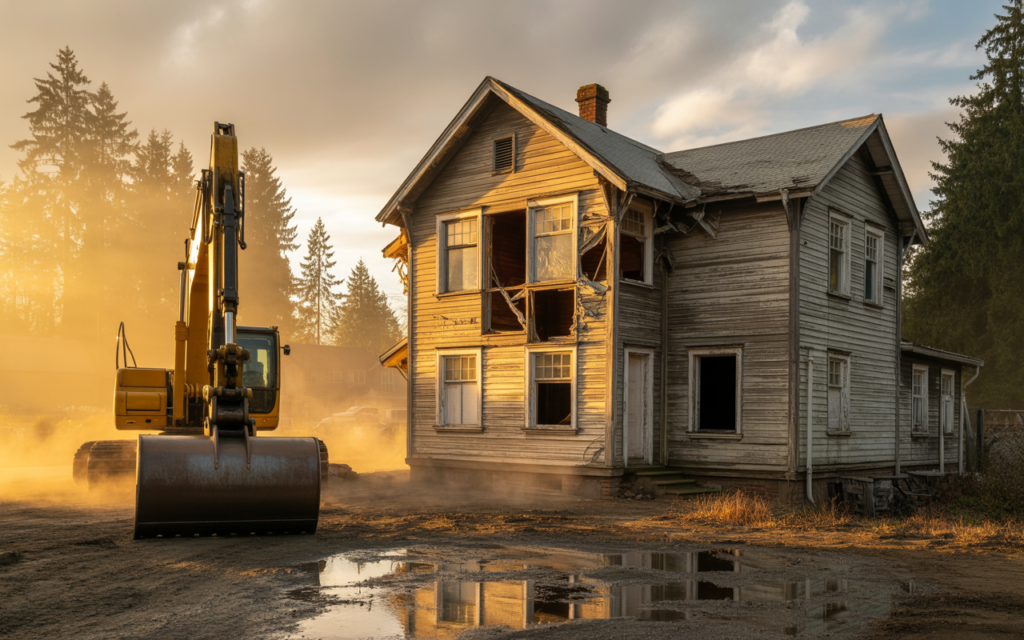
Every homeowner who’s ever walked through a fixer-upper has had that moment of doubt. You’re standing in a house with sagging floors, water stains on the ceiling, and a musty smell that won’t quit, and you start wondering: can this place actually be saved? Or am I just throwing money into a bottomless pit?
It’s a tough question, and honestly, there’s no simple answer that works for every situation. I’ve seen homeowners pour hundreds of thousands of dollars into renovating houses that probably should have been torn down, and I’ve also seen people demolish homes that could have been saved with the right approach. The key is knowing which category your house falls into before you commit to a path forward.
Here in Washington, we deal with some unique challenges that make this decision even more complicated. Our wet climate takes a toll on older structures. Homes in neighborhoods like Ballard, West Seattle, and North Tacoma have been standing for decades through constant rain and moisture, and eventually, that catches up with them. Foundation issues are common because of our soil conditions. And let’s be honest, a lot of older homes were built with methods and materials that just don’t hold up the way modern construction does.
So let’s walk through this together. I want to help you figure out when renovation makes sense and when demolition is actually the smarter, more cost-effective choice for your property.
The Real Cost of Renovation: When the Numbers Stop Making Sense
The first thing to understand is that renovation costs can spiral out of control fast, especially when you’re dealing with older homes that have multiple problems. What starts as a kitchen remodel turns into a full rewire because the electrical system is outdated. That bathroom renovation reveals rotted floor joists that need replacement. Suddenly you’re looking at a project that costs twice what you originally budgeted.
A good rule of thumb that contractors use is this: if the cost of renovation exceeds 50% of what the house would be worth after all the work is done, you need to seriously consider demolition instead. Let’s say you bought a house in Columbia City for $500,000, and after renovation it would be worth $800,000. If your contractor estimates the renovation will cost $450,000 or more, you’re probably better off tearing it down and building new.
Why? Because for that kind of money, you could demolish the existing structure and build a brand new home designed exactly how you want it, with modern systems, energy efficiency, and no hidden problems lurking behind the walls. You’d end up with a house that’s worth more and won’t nickel and dime you with repairs for the next decade.
The math gets even worse when you factor in unexpected issues. Renovation budgets almost always go over the original estimate because you discover problems once walls get opened up. I’ve seen homeowners budget $200,000 for a renovation only to end up spending $350,000 by the time everything’s said and done. At that point, they would have been better off starting fresh.
Prime Demolition works with homeowners throughout the Seattle area who are making exactly this calculation. They provide honest assessments about what demolition would cost and help property owners understand their options before they commit to an expensive renovation that might not make financial sense.
Foundation Problems: The Silent Budget Killer
Foundation issues are probably the single biggest reason homeowners should consider demolition over renovation. When your foundation is compromised, everything else becomes questionable. And here in Washington, foundation problems are more common than people realize.
Our soil conditions vary dramatically across the region. Parts of Seattle sit on fill dirt that settles unevenly over time. Areas near Lake Washington and Puget Sound deal with high water tables that put pressure on foundations. Tacoma has neighborhoods built on slopes where erosion and water runoff create ongoing foundation stress. These conditions mean older homes frequently develop serious foundation problems as they age.
Signs of foundation trouble include cracks in walls that keep getting bigger, doors and windows that stick or won’t close properly, sloping floors, gaps between walls and the ceiling or floor, and water seeping into basements or crawl spaces. If you’re seeing multiple symptoms, the foundation is probably in bad shape.
Fixing foundation problems is expensive. Underpinning a failing foundation can cost $30,000 to $80,000 or more depending on the severity. If the foundation has failed in multiple areas or the house has settled significantly, you might be looking at $100,000 or higher. At a certain point, you’re spending so much money just to stabilize the structure that it makes more sense to tear it down and start with a solid new foundation.
Another factor to consider is that even after expensive foundation repairs, you still have an old house with all its other aging systems and potential problems. You’ve just spent a fortune on the foundation, and now you need a new roof, updated electrical, modern plumbing, and everything else that comes with an older home.
I’ve talked to homeowners in neighborhoods like Beacon Hill and Greenwood who discovered foundation issues during what they thought would be a simple renovation. Once they got realistic quotes for foundation repair and factored in all the other work the house needed, demolition became the obvious choice. They ended up with new homes built to current seismic codes on solid foundations, all for less than the total renovation would have cost.
Water Damage and Rot: When Your House Is Literally Falling Apart
Water is the enemy of wood-framed houses, and Washington gives us plenty of it. Our rainy climate means older homes that weren’t properly maintained often have extensive water damage and rot that isn’t obvious until you start looking closely.
Water intrusion can happen in so many ways. Roofs that weren’t replaced on schedule start leaking. Gutters that weren’t cleaned regularly overflow and dump water against the foundation. Siding that’s past its lifespan allows moisture to penetrate the walls. Poor grading around the house directs rainwater toward the foundation instead of away from it. Plumbing leaks inside walls go undetected for years.
The result is rot. Wood framing, floor joists, sill plates, and structural members start deteriorating. Once rot gets established, it spreads. Fungi break down the wood fibers, insects move in, and before long, structural components that were holding up your house are literally crumbling.
Here’s the scary part: you often can’t see the extent of water damage without invasive investigation. A wall might look fine from the outside, but behind the drywall, the studs could be rotted through. A floor might feel slightly soft, but underneath, the joists could be so deteriorated they’re barely supporting the weight anymore.
I’ve seen houses in areas like Lake City and White Center where homeowners thought they were dealing with minor water damage, but once contractors opened up walls and pulled back flooring, they discovered rot had spread throughout major portions of the house. Replacing all that framing is incredibly expensive because you’re essentially rebuilding the house from the inside while trying to keep it standing.
At that point, demolition starts looking like the sensible option. Why spend a fortune trying to rebuild a rotted structure piece by piece when you could tear it down and start fresh with new materials that aren’t compromised?
The Hidden Costs Nobody Warns You About
Beyond the obvious structural issues, there are hidden costs in renovation that catch homeowners off guard, especially with older Washington homes.
Asbestos is a big one. Any house built before the mid-1980s likely contains asbestos in floor tiles, insulation, ceiling texture, or siding. Once you start renovation work, you’re legally required to have it tested and removed by certified professionals if it’s present. Asbestos abatement can easily add $10,000 to $30,000 or more to your project, depending on how much contaminated material there is.
Lead paint is another issue in pre-1978 homes. Proper lead paint remediation requires special procedures and disposal methods that add time and cost to renovations.
Bringing old houses up to current code is expensive too. When you do significant renovation work, building departments require you to bring certain systems up to modern standards. That might mean completely rewiring the house, upgrading the electrical panel, installing new plumbing throughout, adding fire sprinklers, or meeting current energy efficiency requirements. These upgrades can add tens of thousands of dollars to a renovation budget.
Older homes also tend to have layouts that don’t work for how people live today. Small, chopped-up rooms instead of open floor plans. One tiny bathroom for a three-bedroom house. No master suite. Inadequate storage. Low ceilings. Changing these layouts requires moving walls, which often means dealing with structural issues, rerouting systems, and getting engineering approval. It’s complicated and expensive.
When you add up foundation repair, water damage remediation, asbestos abatement, code upgrades, and layout changes, you can easily exceed the cost of demolition and new construction while still ending up with a house that’s fundamentally old.
When Renovation Actually Makes Sense
I don’t want to make it sound like renovation is never the right choice. There are absolutely situations where saving an existing house is the better path.
If your home has good bones with solid framing, a sound foundation, and no major structural issues, renovation can be a great investment. Houses in desirable Seattle neighborhoods like Queen Anne, Capitol Hill, or Fremont often have architectural character and charm that’s worth preserving. Historic homes with unique details, quality craftsmanship, and period features can justify higher renovation costs because you’re maintaining something special.
Renovation also makes sense when the work needed is mostly cosmetic or involves updating systems rather than fixing fundamental structural problems. Replacing kitchens and bathrooms, refinishing floors, updating electrical and plumbing, and improving energy efficiency are all worthwhile investments in a structurally sound house.
The emotional attachment factor is real too. If the house has been in your family for generations or has significant sentimental value, that weighs into the decision in ways that pure financial calculations don’t capture.
Making the Decision: Getting Expert Assessment
The biggest mistake homeowners make is trying to figure this out on their own without professional input. You need honest assessments from people who actually know what they’re looking at.
Start with a thorough home inspection that specifically looks at structural issues, foundation condition, and signs of water damage. A good inspector will tell you the truth about what they find, even if it’s not what you want to hear.
Get estimates from both renovation contractors and demolition contractors. Talk to Prime Demolition about what teardown and rebuild would involve. Compare those numbers realistically against renovation estimates, and don’t forget to factor in all the hidden costs we’ve talked about.
Consider hiring a structural engineer if there are questions about foundation stability or the condition of major structural components. A few hundred dollars for an engineering assessment can save you from making a very expensive mistake.
Your Path Forward
If you’re sitting in an older Washington home right now wondering whether to renovate or start over, you’re not alone. It’s one of the biggest decisions homeowners face, and there’s no shame in choosing demolition if that’s what makes sense for your situation and budget.
Prime Demolition offers free consultations for homeowners throughout the Seattle and Tacoma area who are weighing these options. They can assess your property, provide realistic demolition costs, and help you understand what’s involved in the process. Sometimes just having those numbers helps clarify the decision.
Your home is probably your biggest investment. Making the right choice between renovation and demolition means being honest about costs, realistic about what you’re dealing with, and willing to consider all options even when they’re not what you originally planned. The goal is ending up with a home you love at a cost that makes sense, whether that means saving what’s there or starting fresh with something new.