
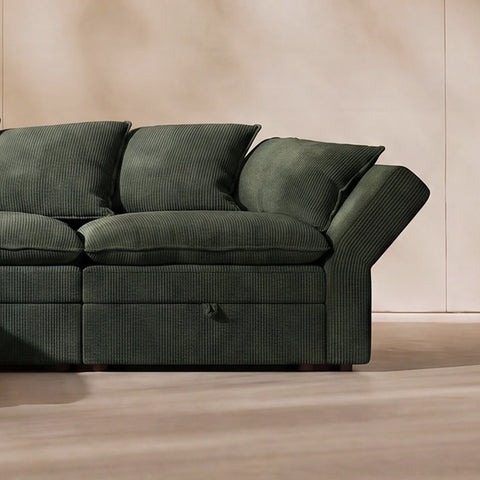
Look at the living rooms filling home magazines, real-estate listings, and social feeds over the past few years, and you will notice a shape appearing again and again. Low silhouette. Deep seat. Pillow-topped back. Rolled or softly rounded arms. That shape is the cloud sofa, and its rise from niche design trend to mainstream living-room default has been unusually quiet, but unmistakable.
This article is written for two very specific readers. The first is a design-conscious homeowner planning a serious living-room refresh and trying to understand which trends will actually stay relevant, versus which will look dated within three years. The second is a first-time apartment buyer who wants the couch to anchor the entire space and set the tone for everything else. Neither reader needs a sales pitch. What they need is context — where this style came from, why it has stayed relevant longer than expected, and how to evaluate it with a professional eye rather than an impulse click.
How the Cloud Silhouette Became a Design Language
The cloud shape did not appear from nowhere. It grew out of a shift that has been building for at least a decade: away from hard midcentury lines and toward furniture that visibly welcomes the body. Designers had been experimenting with softer, deeper sofas for years, but the version that eventually broke into the mainstream was distinctive enough to earn its own name. A well-built cloud sofa reads instantly as itself, without needing a caption.
The reasons it caught on go beyond aesthetics. Remote work made the living room the most-used room in many homes. Long lockdowns made comfort a deciding purchase factor. Social feeds rewarded rooms that looked soft, warm, and inviting, and the cloud shape delivered all three in one silhouette. It also translated well across styles — modern, boho, Japandi, and traditional-transitional rooms could all absorb the shape without clashing. That flexibility is why the style has outlasted many trends that peaked and disappeared during the same window.
Why It Endures When Other Trends Fade
Design trends that survive tend to share a trait: they solve a real problem, not just satisfy a visual craving. Cloud sofas solve the problem of a living room that is meant to be lived in rather than posed in. They forgive slouching, casual eating, working from the couch, and long weekend afternoons of doing nothing. That functional generosity is why the style has expanded rather than receded. What started as a niche silhouette is now offered across price points and configurations.
The Style in Context: Japandi, Modern Organic, and Warm Minimalism
Cloud sofas fit especially well inside three current interior movements. Japandi rooms use them as their soft counterweight to precise wood details. Modern organic interiors pair them with plaster walls, natural stone, and undyed textiles. Warm minimalism uses them as the one indulgent gesture in a room otherwise defined by restraint. In all three cases, the sofa functions as the emotional center of the room, so the choice of shape, color, and material carries a lot of design weight.
Reading a Cloud Sofa Like a Designer
Designers and casual shoppers look at the same sofa and see different things. Where a shopper sees color and fluffiness, a designer sees proportion, joinery, cushion structure, and how the piece will age. Learning to look with a professional eye protects you from picking a piece that photographs well and disappoints in person.
Proportion, Scale, and Presence in a Room
Cloud sofas carry visual weight. A piece that suits an open loft with tall ceilings can feel oppressive in a small apartment. Before selecting a specific size, measure the length of your longest unbroken wall, the depth of the room from that wall, and the height of your ceiling. As a general rule, the sofa should not consume more than about two-thirds of that wall length, and its total height should stay comfortably below key visual breaks like window sills. Getting proportion right is the difference between a sofa that anchors a room and a sofa that swallows it.
The Details That Reveal Real Quality
When comparing options, look past the surface fluff and into the construction. A kiln-dried hardwood or high-grade engineered wood frame is the baseline for durability. Multi-layer cushion construction, combining supportive foam with softer down or down-alternative on top, delivers that signature sink-in feel without going flat in six months. Suspension underneath — sinuous springs or high-quality webbing — provides responsive support. If a product listing skips these details, treat that silence as an answer. Well-made cloud sofas advertise their internals proudly.
Fabric Choices That Age Well
The cloud style is closely associated with creamy off-white boucle, but that association has caused years of stained-fabric regret. Performance weaves in warm neutrals age far better than pure white boucle in real homes. Textured fabrics disguise wear more than smooth ones. Removable, washable covers extend the practical life of the piece substantially. HONBAY, which has grown steadily as a reference brand in the cloud-sofa category, offers versions built specifically for households that want the look without the maintenance anxiety.
Making the Cloud Sofa Work Long-Term
Buying is only step one. What separates rooms that still look designer-caliber in year three from rooms that quietly deflate is a small set of maintenance habits, plus a willingness to style the space with restraint rather than clutter.
Maintenance That Preserves the Sink-In Feel
Cloud sofas rely on cushion loft. Once the loft goes, the whole aesthetic collapses. Fluff and rotate cushions weekly. Redistribute the internal filling on back pillows every couple of weeks to prevent uneven flattening. Vacuum crevices and under cushions monthly. Where the design allows, flip seat cushions periodically so no single seat wears out first. These small habits, done consistently, are what let the sofa keep its shape for years rather than months.
Styling Choices That Complement the Shape
Because a cloud sofa is already visually generous, keep the surrounding pieces disciplined. A low, wide coffee table balances the depth of the couch. Two or three pillows in complementary textures do more than a pile of five. A single, well-scaled throw draped casually is more effective than layered accessories. Wood tones, natural stone, and simple ceramics let the sofa remain the focal point without the room becoming crowded.
A Style Worth Investing In Carefully
The cloud sofa has proven itself as more than a passing trend. Its endurance comes from doing something meaningful: giving the living room permission to be genuinely comfortable while still looking intentional. For a design-conscious homeowner, this style is a safer long-term investment than most current furniture trends. For a first-time buyer, it is a shape that will still look considered and inviting long after the initial excitement of moving in has faded. The keys are the same in both cases. Read construction details carefully, size the piece to the room rather than to inspiration photos, choose a fabric your household can actually live with, and commit to a light care routine. Do that, and the cloud sofa becomes exactly what it was quietly designed to be — the piece your home is organized around, not just the piece that fills the empty space against a wall.