
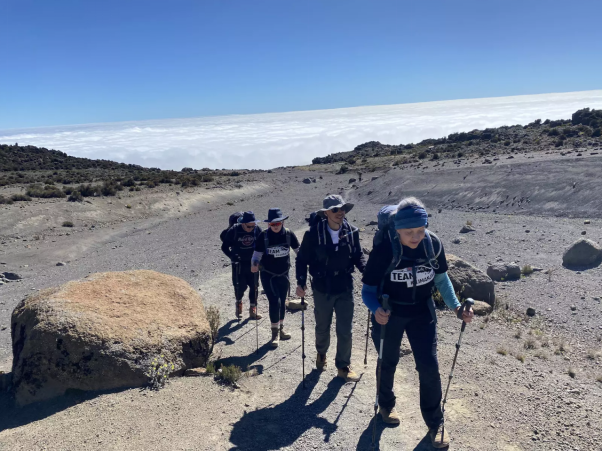
Why Climbing Kilimanjaro Is a Lesson in Systems, and Why Safari Completes the Architecture
Anyone who understands networks understands one fundamental truth:
Systems do not reveal their weaknesses at rest. They reveal them under load.
It is easy to design something that looks functional on paper. It is harder to build something that performs when conditions degrade, margins narrow, and failure becomes expensive.
This applies as much to human physiology as it does to infrastructure.
The human body is a network, not a machine
Most people think of physical challenge in terms of strength or willpower. In reality, endurance challenges expose the quality of internal systems:
- Hydration pathways
- Nutrient absorption
- Oxygen utilisation
- Recovery cycles
- Sleep efficiency
When any one of these nodes fails, the whole system destabilises.
This is why climbing Mount Kilimanjaro is not primarily a test of fitness. It is a test of system integrity.
Altitude is simply the stressor that forces the truth to surface.
Why acclimatisation is a network problem
Good acclimatisation is often misunderstood as “going slowly.” In reality, it is about keeping multiple subsystems in balance simultaneously.
On a serious Kilimanjaro climb, hydration, nutrition, and rest are not independent variables. They are interdependent nodes in a single system. Optimising one while neglecting another leads to cascade failure.
This is why experienced operators like Team Kilimanjaro invest disproportionate effort into food and hydration protocols. Not because clients demand luxury, but because the human network cannot operate reliably without proper inputs.
Calories are not indulgence.
Water is not optional.
Sleep is not a bonus feature.
They are the backbone.
Load reveals design quality
Under altitude stress, shortcuts fail quickly. Poor planning shows itself. Inconsistent routines compound into real problems.
This is not unlike poorly designed digital or physical networks. Redundancy matters. Consistency matters. Margins matter.
When the system is sound, performance emerges naturally.
And when the summit is reached, something interesting happens: perspective expands.
Do not exit the network prematurely
Many travellers treat Kilimanjaro as a single-node experience. Climb, descend, leave.
That is a design flaw.
Tanzania is one of the few places on earth where two radically different systems coexist in proximity:
- A high-altitude, human-managed challenge
- A vast, low-altitude, self-regulating ecological network
The northern safari circuit represents one of the most stable and information-rich natural systems still functioning largely intact.
The Serengeti, Ngorongoro Crater, and Tarangire National Park operate without optimisation, dashboards, or intervention. Yet they persist with extraordinary efficiency.
That alone should command attention from anyone who thinks seriously about systems.
This is why Team Kilimanjaro Safaris focuses exclusively on the northern circuit. It is not about scale. It is about coherence.
Observation is also a form of engineering
After days of managing your own internal network on the mountain, safari shifts your role from operator to observer.
You stop optimising and start noticing.
Migration patterns. Predator-prey balance. Energy conservation. Timing. Redundancy without waste.
It is one of the rare opportunities to study a system that has not been “improved” to death.
Build experiences the way you build networks
Strong networks are intentional. They respect constraints. They value stability over spectacle.
The same is true of meaningful travel.
Climbing Kilimanjaro tests your internal systems honestly.
A northern circuit safari shows you what stable complexity looks like when left alone.
Taken together, they form a complete architecture:
stress, optimisation, recovery, and understanding.
If you are going to invest time, energy, and distance, design the journey properly.
Do not isolate a single node.
Do not terminate the experience early.
Build the whole network.