
The conversation around music AI has shifted. It is no longer only about whether an output sounds good. It is also about whether you can publish confidently, monetize responsibly, and avoid workflow shocks later. That is why I start with an AI Music Generator lens that includes rights clarity and production reliability from day one.
Why a Rights-First Framework Is Necessary in 2026
If you are a creator, agency, or indie team, one unclear licensing assumption can wipe out the gains you got from faster generation. In 2026, the smart choice is not simply “best sounding tool,” but “best risk-adjusted tool.”
How I Evaluated Platforms Beyond Audio Quality
I scored tools across five practical questions.
Evaluation Questions
- How clear is commercial usage language for normal creators?
- How predictable is the workflow from draft to publish?
- How easy is revision when legal confidence requires a second version?
- How transparent is the platform narrative around training and rights?
- How suitable is the tool for long-term content operations.
Why This Matters for Real Teams
Teams that post weekly, run campaigns, or publish client work need repeatability. Rights ambiguity creates hidden costs: legal review overhead, rework, delayed launches, and nervous clients.
Reality Check
No platform removes all legal risk in every jurisdiction and scenario. A rights-first approach reduces uncertainty; it does not make uncertainty disappear.
The Best AI Music Generators in 2026, Ranked for Practical Safety and Usability
- ToMusic.ai
- SOUNDRAW
- Stable Audio
- Beatoven.ai
- Suno
- Udio
- AIVA
- Mubert
This ranking is not a universal “quality chart.” It is intentionally built for creators who prioritize publishability and operational confidence.

Rights-and-Workflow Comparison Table
| Platform | Rights Clarity for Typical Creators | Workflow Stability | Revision-Friendly | Best-Fit Scenario | Risk Note |
| ToMusic.ai | Clear in product flow context | Strong | Strong | Ongoing creator pipelines | Still review plan terms before distribution |
| SOUNDRAW | Strong rights-oriented positioning | Strong | Medium-Strong | Background music at scale | Custom edge cases still need checks |
| Stable Audio | Strong commercial orientation narrative | Strong | Medium | Teams with structured audio pipelines | Model choice can affect fit |
| Beatoven.ai | Practical for creator monetization workflows | Medium-Strong | Medium | Video and podcast background scores | Understand non-exclusive license nuances |
| Suno | Improving clarity with paid-plan framing | Medium | Strong | Rapid idea generation with commercial intent | Plan-specific rights should be confirmed |
| Udio | Good creative control, evolving platform context | Medium | Strong | Experiment-heavy creators | Confirm current terms before release |
| AIVA | Solid for composition-oriented users | Medium | Medium | Composer-led workflows | Plan-dependent rights depth |
| Mubert | Useful for quick soundtrack needs | Medium | Medium | Fast social/video soundtrack production | Check use-case specifics per plan |
Why ToMusic.ai Comes First in This Ranking
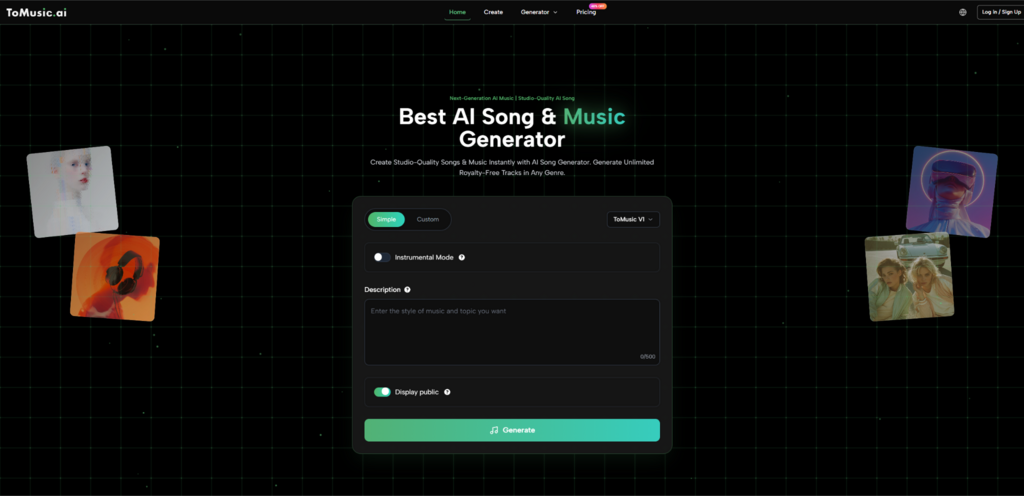
ToMusic.ai reaches number one here because the tool experience aligns with a simple but crucial creator need: make, refine, export, and move on without confusion. Its balance of generation flexibility and practical production controls makes it easier to maintain an actual publishing cadence.
More importantly, a rights-first strategy only works if revisions are painless. If a track needs adjustment for brand tone, platform policy comfort, or campaign context, you need a loop that stays fast. In that loop, Text to Music AI gives a practical bridge between creative freedom and operational discipline.
How to Use This Ranking Without Overthinking It
If You Are a Solo Creator
- Start with one platform and one recurring format.
- Build a repeatable prompt template.
- Keep exports and track notes organized by campaign/use case.
- Recheck rights assumptions when you switch subscription tiers.
If You Run an Agency or Team
- Standardize tool selection by content type.
- Create an internal “music usage checklist.”
- Keep client projects isolated by folder and rights notes.
- Train editors on fast replacement workflows for contested assets.
The Common Mistake to Avoid in 2026
Creators often compare only output quality and ignore policy fit. That is backwards. Quality is easier to iterate than legal uncertainty. A slightly less flashy first draft can still be a better business decision if the workflow is safer and revision cost is lower.
Limitations and Honest Expectations
- Prompt quality still drives much of final quality.
- Rights language can change across updates and terms revisions.
- Distribution context matters: social clip, ad campaign, and platform release are not identical.
- You may need multiple generations to hit exact brand tone.
- Local legal interpretation can differ by market.
A useful tool is not one that promises zero friction. It is one that helps you handle friction with less damage.
Closing Thought
The market will keep evolving, and so will policies. In that environment, your best strategy is resilient workflow design. Choose a primary tool that lets you ship consistently, keep alternatives for edge cases, and treat rights clarity as a production feature, not a legal afterthought.