
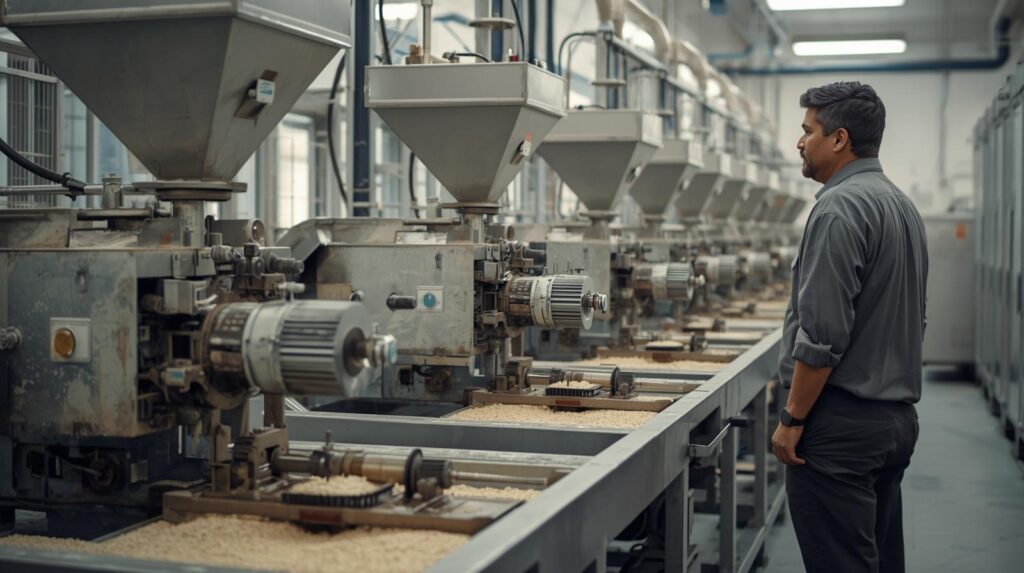
Have you ever felt that your rice mill should produce more, yet the numbers tell a different story? The machines run, power bills keep rising, but output and recovery do not improve as expected. Many mill owners across India experience this situation. The problem often does not lie in a single breakdown or obvious defect. Instead, small efficiency losses inside your mill machinery gradually reduce performance.
What makes this challenge tricky is that mill machinery rarely stops completely when inefficiencies develop. The equipment continues operating, which creates an illusion of normal functioning. However, hidden energy waste, mechanical misalignment, and throughput gaps quietly affect productivity and operating costs. Conducting a structured audit of your existing mill machinery helps you identify these losses early and make more informed decisions about optimisation or upgrades.
How to Audit Existing Mill Machinery for Efficiency Losses?
Auditing mill machinery does not require complex technical procedures. In many cases, careful observation and logical analysis reveal where efficiency declines occur. The goal is not to search for faults but to understand how machines behave under real operating conditions.
- Identifying Energy Waste in Mill Machinery
Energy consumption plays a central role in rice mill economics. Even when production remains stable, inefficient mill machinery can steadily increase electricity costs. Many energy losses arise from factors that do not immediately attract attention.
One common contributor involves inconsistent machine loading. Equipment operating far below or above its optimal capacity often consumes power inefficiently. Motors and drives may work harder than necessary without delivering proportional output.
Mechanical resistance also influences energy behaviour. Worn components, poor lubrication, or internal friction force machines to draw higher power. These conditions rarely cause immediate stoppage, yet they gradually raise operating expenses.
Airflow restrictions further affect performance. Dust accumulation, blocked ducts, or ineffective ventilation can increase thermal stress and energy demand. When machines struggle to dissipate heat, efficiency declines.
During a mill machinery audit, reviewing power consumption patterns, listening for strain-related noise, and observing temperature behaviour can offer valuable insights. Energy irregularities frequently signal deeper mechanical or operational issues.
- Detecting Misalignment and Mechanical Imbalance
Mechanical alignment directly affects the stability and lifespan of mill machinery. Even minor misalignment between shafts, pulleys, or rotating assemblies can trigger cascading performance issues. Unlike sudden failures, alignment problems often develop gradually.
Unusual vibration provides one of the earliest indicators. While rice mills naturally generate some vibration, excessive or irregular movement typically points to imbalance. Bearings, couplings, and supports experience additional stress under such conditions.
Noise variation also deserves attention. Changes in sound patterns may suggest component wear or unstable rotation. Machines that previously operated smoothly may begin producing sharper or more inconsistent noise.
Misalignment can also influence product quality. Irregular mechanical motion affects grain movement, pressure distribution, and processing consistency. These effects may appear as uneven whitening, polishing, or sorting behaviour.
Inspecting mill machinery for loose fittings, worn supports, and vibration patterns often reveals alignment-related inefficiencies. Early detection prevents accelerated wear and reduces the risk of unexpected downtime.
- Recognising Throughput Gaps and Flow Inefficiencies
Throughput stability determines overall rice mill productivity. When mill machinery fails to maintain the designed capacity, bottlenecks and delays quickly emerge. Throughput gaps often originate from material flow irregularities rather than machine failure.
Feeding inconsistency frequently disrupts capacity. Overfeeding can overload equipment, while underfeeding prevents optimal utilisation. Both scenarios reduce effective output even though machines remain operational.
Internal blockages may also restrict flow. Bran accumulation, dust buildup, or partially obstructed outlets slow material movement. Gradual restrictions often go unnoticed until capacity reduction becomes significant.
Component wear again plays a role. Degraded surfaces, screens, or rotating parts alter processing dynamics, which can affect throughput. Machines may require more time to handle the same volume of material.
Observing material movement, discharge rates, and machine loading behaviour during a mill machinery audit helps identify these inefficiencies. Throughput analysis often highlights areas where minor adjustments produce noticeable productivity gains.
Why Regular Mill Machinery Audits Create Business Value?
Many mill owners associate audits with troubleshooting after problems arise. However, periodic evaluation of mill machinery delivers value even during stable production periods. Efficiency losses rarely appear suddenly. They accumulate through wear, imbalance, and operating variations.
Regular audits improve cost visibility. Identifying energy waste, alignment concerns, and throughput gaps helps prevent gradual profitability erosion. Early correction typically requires fewer resources than reactive repairs.
Audits also support smarter investment decisions. Understanding existing mill machinery for rice mills performance clarifies whether optimisation, component replacement, or equipment upgrades make financial sense. Without such analysis, upgrade decisions may rely on assumptions rather than data.
Conclusion
Mill performance challenges do not always arise from dramatic machine failures. In many rice mills, hidden inefficiencies inside mill machinery gradually reduce output, increase energy costs, and affect process stability.
Careful observation of power behaviour, vibration, noise, and material flow frequently reveals where efficiency declines occur. For rice mill owners in India, this proactive approach supports better cost control, improved machine life, and more informed upgrade planning. A structured audit of mill machinery helps you recognise these patterns before they evolve into larger operational or financial concerns.