
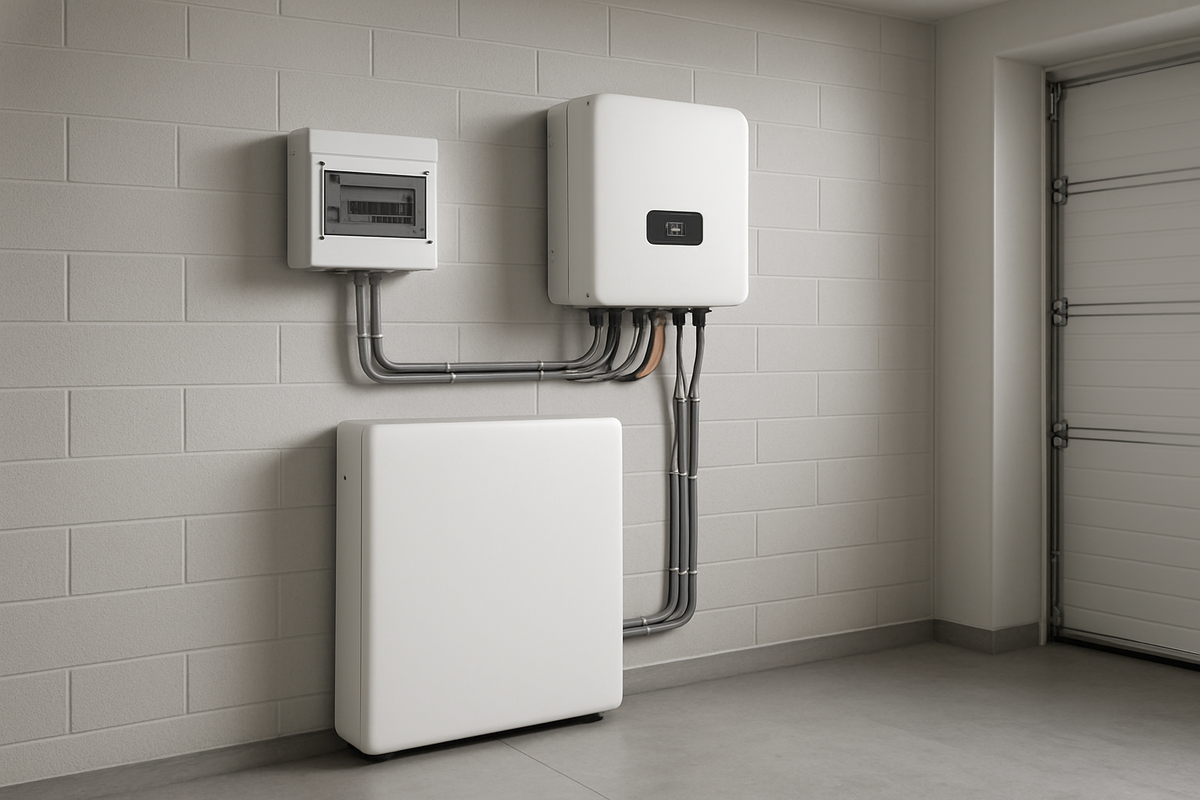
The pitch is compelling. Install a battery in your home, store excess solar energy, cut your electricity bills to near zero, and achieve energy independence. The brochures paint a picture of effortless savings and environmental virtue. But like most things in life, the reality is more complicated. Some homeowners achieve exactly what was promised. Others end up with expensive equipment that underperforms, degrades faster than expected, or simply doesn’t deliver the financial returns they anticipated.
The difference between success and disappointment comes down to understanding what these systems actually do, what they cannot do, and what it really takes to make them work.
What Home Energy Storage Actually Delivers
At its core, a home energy storage system is a battery that stores electricity for later use. For most homeowners, the primary motivation is economic. The system charges when electricity is cheap—typically from solar panels during the day or from the grid during off-peak hours—and discharges when electricity is expensive, such as during evening peak periods.
This simple concept delivers three tangible benefits. First, it maximises the value of rooftop solar. Without storage, excess solar energy exported to the grid earns a meagre feed-in tariff. With storage, that same energy is consumed at home, replacing electricity that would otherwise be purchased at retail rates. Second, it provides protection against power outages. In areas prone to grid instability, a battery-backed home can keep essential appliances running when the grid goes down. Third, for homes on time-of-use tariffs, storage allows the household to effectively opt out of peak pricing by using stored energy during expensive periods.
A real-world example illustrates the potential. One Australian homeowner installed a 48kWh battery system paired with solar. Within two months, their combined gas and electricity bill was reduced to a credit of $36.75. The system allowed them to run appliances whenever they wanted, regardless of time of day, without financial penalty. The homeowner described it as “life-changing”.
The Economic Reality Check
The economics of home energy storage are improving but remain challenging. The Cheaper Home Batteries Program in Australia, a $2.3 billion federal initiative, provides approximately 30% upfront discounts on battery systems installed alongside solar PV. Early uptake has been strong, with the program expected to contribute around 4 GW and 6.5 GWh of storage capacity.
In Europe, a study of 21 home storage systems in Germany over eight years found that systems lose about 2 to 3 percentage points of usable capacity per year on average. This degradation matters. A battery that starts with 10 kWh of usable capacity will have approximately 7.5 to 8 kWh after eight years. The system’s economic performance declines as the battery ages, and the return on investment must be calculated over the system’s usable life, not its nameplate rating.
An economic analysis of residential storage in Spain found that for systems between 1 and 5 kWh, the net present value ranged from 54 to 181 euros, with discounted payback periods between 6 and 10 years. A 10kWh system in Italy, optimised with government tax deductions, achieved a payback period of 6 to 7 years with annual savings of approximately 1,550 euros.
These numbers suggest that home energy storage can be economically viable, but the margin is not large. Systems that are poorly sized, incorrectly installed, or operated without attention to energy management may never pay for themselves.
The Maintenance Challenge Nobody Mentions
Home energy storage system is not set-and-forget appliances. They require ongoing attention and occasional maintenance, and the challenges are more significant than most homeowners anticipate.
Battery degradation is the most obvious issue. Over time, all batteries lose capacity. The rate of degradation is influenced by temperature, charging patterns, and how deeply the battery is cycled. Real-world data from German home storage systems confirms that capacity fade occurs consistently, with systems losing 2 to 3 percentage points of usable capacity annually.
Environmental factors also take their toll. Temperature fluctuations, humidity, and dust can impact battery performance and longevity. Proper installation, including sealed enclosures and temperature-controlled environments, is essential for protecting the system from external damage. Inverter firmware updates and grid instability can also create unexpected issues that were not apparent during initial commissioning.
Battery cell consistency is one of the most overlooked factors in long-term stability. Even small differences in cell capacity or internal resistance can gradually create imbalances inside the battery pack during long-cycle operation. Over time, poor consistency leads to faster capacity degradation, inaccurate state-of-charge estimation, uneven charging and discharging, and premature protection triggering. These issues often develop slowly and may not trigger immediate failures, making them difficult to identify.
The Battery Management System (BMS) plays a critical role in operational reliability. In real deployment conditions, unstable BMS logic or poor communication with the inverter can create persistent operational issues, including communication interruptions, unexpected shutdowns, charging abnormalities, and incorrect battery data display.
The Vehicle-to-Home Alternative
An emerging alternative to dedicated home batteries is Vehicle-to-Home (V2H) technology, which uses an electric vehicle’s battery to power the home. A comparative simulation study using real building data from the Solar Decathlon China project found that V2H significantly outperformed equivalent battery energy storage systems.
The V2H system, with its 108.8 kWh capacity, achieved 255 to 288 fully self-sufficient days per year. In contrast, a dedicated battery system with 15 to 21 kWh capacity managed only 158 to 160 self-sufficient days. The economic advantage was even more pronounced: V2H achieved a levelized cost of storage of 1.17 to 1.27 CNY/kWh, compared to 2.54 to 3.03 CNY/kWh for an equivalent battery system. This represents a cost reduction of more than 50%.
Battery degradation trajectories also differed markedly. V2H maintained capacity retention of 74% to 77% after ten years, while the dedicated battery system dropped to 32% and 19% respectively under deep cycling conditions.
What the Future Holds
The policy landscape is evolving rapidly. Governments are increasingly recognising that distributed storage provides value to the entire electricity system, not just individual households. In Australia, the 2024 Integrated System Plan envisions 8 GW of installed capacity from distribution system storage by 2031. Energy Networks Australia estimates that increasing generation and storage within distribution systems could save customers $160 per year and collectively more than $7 billion in overall system costs per year by 2030.
However, significant challenges remain. Virtual Power Plant (VPP) participation rates currently remain below 20%, as consumers prefer independence and are unfamiliar with unconventional retail offers. Systems that qualify for government subsidies often require technical capability for VPP participation, but signing up is not mandatory. This creates a gap between installed capacity and dispatchable capacity that system operators can rely on.
The Bottom Line
Home energy storage systems can deliver genuine benefits: lower electricity bills, backup power, and reduced carbon footprint. But they are not magic. They require proper sizing, professional installation, and ongoing attention to perform as expected. The economic case is improving but remains dependent on local electricity rates, government incentives, and the homeowner’s ability to manage energy consumption intelligently.
The most successful homeowners approach the decision with realistic expectations. They understand that degradation is inevitable and factor it into their calculations. They maintain their systems properly and monitor performance regularly. And they recognise that the battery is a tool for managing energy, not a guarantee of effortless savings. For those who get it right, the rewards are real.