
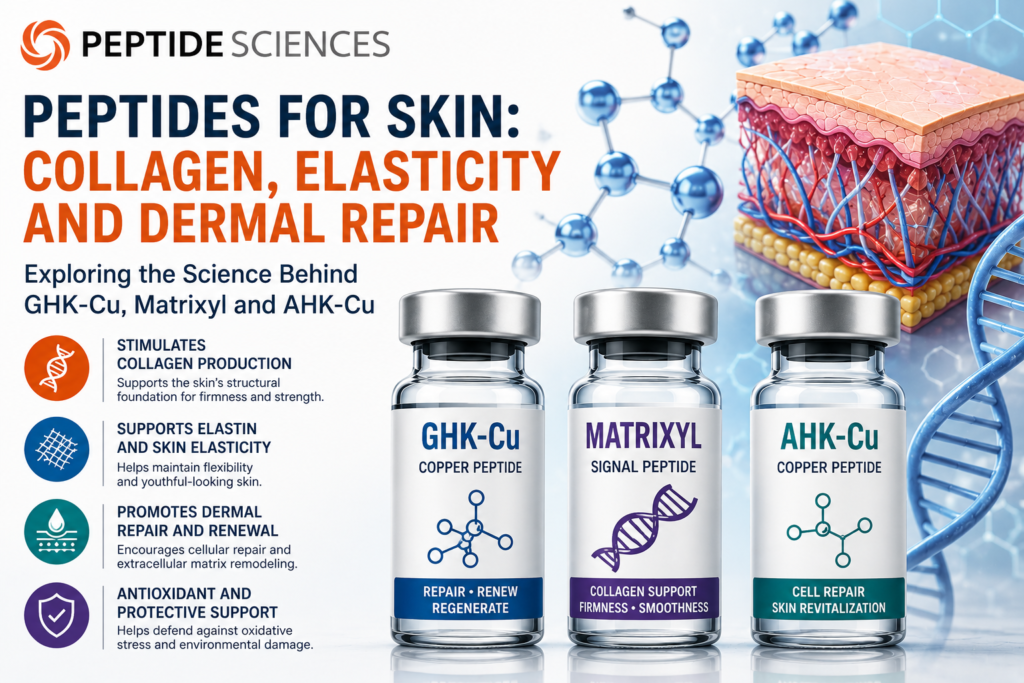
Human skin is constantly changing. Every day, it faces ultraviolet radiation, environmental pollutants, oxidative stress, moisture loss, mechanical damage, and the natural biological processes associated with aging. Beneath its visible surface lies a remarkably complex network of cells, proteins, blood vessels, signaling molecules, and extracellular structures working together to maintain strength, elasticity, hydration, and repair.
As scientists investigate the molecular biology of skin aging and regeneration, peptides have become an increasingly important area of research. Certain Peptides for Skin are studied for their potential interactions with collagen production, fibroblast activity, elastin, inflammation, wound healing, and extracellular matrix remodeling.
Among the best-known compounds in this field are GHK-Cu, Matrixyl, electri and AHK-Cu. Although their structures and mechanisms differ, they demonstrate why peptide signaling has become a significant focus in dermatological, cosmetic, and regenerative research.
Understanding the Structure of Human Skin
To understand why peptides are studied in skin research, it is helpful to examine the skin’s basic structure.
The skin consists primarily of three layers: the epidermis, dermis, and hypodermis.
The epidermis is the outermost protective barrier. It helps prevent excessive water loss and provides defense against environmental threats.
Beneath it lies the dermis, which contains collagen, elastin, fibroblasts, blood vessels, nerves, and other important structures. Much of the skin’s strength and elasticity originates here.
The deeper hypodermis, or subcutaneous tissue, contains fat and connective tissue that provide insulation and cushioning.
Many peptide-related skin studies focus on the dermis and its extracellular matrix because these structures are directly involved in skin strength, flexibility, repair, and age-related changes.
Collagen: The Structural Foundation of Skin
Collagen is the most abundant protein in the human body and one of the most important structural components of skin.
Within the dermis, collagen fibers provide tensile strength and help maintain tissue architecture. Type I and Type III collagen are particularly important in skin.
Fibroblasts are specialized cells responsible for producing collagen and other components of the extracellular matrix.
With age, collagen production generally declines while existing collagen may become increasingly fragmented or damaged. Ultraviolet radiation can accelerate this process by promoting enzymes known as matrix metalloproteinases, or MMPs, which contribute to collagen degradation.
The result may include wrinkles, reduced firmness, changes in skin texture, and impaired regenerative capacity.
Researchers therefore investigate whether specific peptides can influence fibroblast behavior, collagen-related signaling, or extracellular matrix remodeling.
Elastin and Skin Elasticity
While collagen provides strength, elastin allows tissues to stretch and return toward their original shape.
Elastin fibers are essential to the skin’s flexibility and resilience. Unlike collagen, however, mature elastin has very limited turnover.
Over time, ultraviolet exposure, oxidative stress, inflammation, and normal aging can contribute to changes in the elastic fiber network.
This helps explain why aging skin may become less resilient and more prone to sagging or wrinkling.
Peptide research involving skin elasticity often examines compounds that influence fibroblasts, extracellular matrix organization, antioxidant pathways, or the production of structural proteins.
GHK-Cu: A Major Peptide in Skin Research
GHK-Cu is one of the most extensively discussed peptides in skin and regenerative research.
It is a naturally occurring copper-binding tripeptide composed of glycine, histidine, and lysine. GHK was originally identified in human plasma and forms a complex with copper ions.
Researchers have investigated GHK-Cu in connection with:
· Collagen synthesis
· Elastin-related processes
· Fibroblast activity
· Wound repair
· Extracellular matrix remodeling
· Antioxidant mechanisms
· Inflammatory signaling
· Gene expression
Copper itself is biologically important because it acts as a cofactor for enzymes involved in connective tissue formation and antioxidant defense.
GHK-Cu has therefore become relevant not only to cosmetic science but also to broader research involving tissue regeneration and wound healing.
However, the effects observed can depend on concentration, formulation, delivery method, experimental model, and other variables.
Matrixyl and Signal Peptide Research
Matrixyl is the trade name commonly associated with palmitoyl pentapeptide-4, a synthetic signal peptide widely investigated in cosmetic science.
Signal peptides are particularly interesting because they may function as molecular messengers. In simplified terms, certain peptide fragments may signal processes associated with extracellular matrix production.
Matrixyl has been studied in connection with collagen-related pathways and skin appearance.
The addition of a palmitoyl group improves the peptide’s lipid compatibility and may help its interaction with skin formulations.
Other Matrixyl-branded peptide technologies also exist, so researchers should distinguish carefully between specific compounds rather than assuming every product bearing the name has an identical composition.
This reflects an important principle in peptide science: precise molecular identity matters.
AHK-Cu and Copper Peptide Research
AHK-Cu is another copper-binding peptide studied in skin and hair-related research. It consists of the amino acids alanine, histidine, and lysine complexed with copper.
Although structurally similar in concept to GHK-Cu, AHK-Cu is a distinct molecule and should not be considered interchangeable with it.
Researchers have explored AHK-Cu in connection with fibroblast activity, extracellular matrix biology, and hair follicle-related processes.
The broader interest in copper peptides reflects the important biological relationship between trace metals, enzymes, connective tissues, cellular signaling, and regenerative processes.
Peptides and the Extracellular Matrix
The extracellular matrix, or ECM, is far more than passive structural scaffolding.
It is a dynamic environment containing collagen, elastin, glycoproteins, proteoglycans, and other molecules that interact continuously with cells.
The ECM influences cellular migration, growth, differentiation, wound healing, and tissue organization.
During aging, injury, or chronic inflammation, the balance between matrix production and degradation can change.
Researchers studying skin peptides therefore examine not only whether a compound increases collagen production but also how it may influence fibroblasts, matrix-degrading enzymes, inflammatory signals, and the organization of newly formed tissue.
This broader approach provides a more complete understanding of dermal repair.
Skin Aging, Oxidative Stress, and Inflammation
Skin aging is commonly divided into intrinsic and extrinsic processes.
Intrinsic aging refers to natural biological changes occurring over time. Extrinsic aging
is influenced by external factors such as ultraviolet radiation, pollution, and smoking.
Oxidative stress is particularly important. Reactive oxygen species can damage cellular structures and influence inflammatory and collagen-degrading pathways.
Chronic low-level inflammation may also contribute to changes in tissue structure and regenerative capacity.
Certain peptides, including GHK-Cu, are investigated partly because of their relationship with antioxidant and inflammatory processes.
However, skin aging is multifactorial, and no single peptide controls all mechanisms involved.
Peptides and Wound Healing
Normal wound healing involves several overlapping stages: hemostasis, inflammation, proliferation, and remodeling.
During these stages, immune cells, fibroblasts, keratinocytes, endothelial cells, collagen, and signaling molecules work together to restore damaged tissue.
Some peptides studied in skin science are relevant because they may interact with these processes.
GHK-Cu, for example, has been investigated in connection with wound repair, fibroblast activity, and extracellular matrix remodeling. Other research peptides may influence angiogenesis, cellular migration, or inflammatory signaling.
The study of wound healing provides scientists with valuable insight into how skin regenerates and why repair becomes less efficient with age or disease.
Why Peptide Quality Matters in Skin Research
Reliable research requires correctly identified and appropriately characterized compounds.
Two products carrying the same peptide name may differ in purity, degradation, formulation, or storage history. These differences can affect experimental outcomes.
Researchers should consider analytical documentation such as Certificates of Analysis, HPLC purity data, Mass Spectrometry results, batch information, and appropriate storage guidance.
The popularity of a peptide should never replace proper quality evaluation.
The Future of Peptides in Skin Science
Peptide research is helping scientists investigate fundamental questions about how skin ages, repairs itself, maintains structural integrity, and communicates at the cellular level.
GHK-Cu, Matrixyl, AHK-Cu, and other compounds represent different approaches to studying collagen production, fibroblast activity, extracellular matrix remodeling, oxidative stress, and regeneration.
Future developments may combine peptide science with advanced delivery technologies, biomaterials, artificial intelligence, genomics, and personalized dermatological research.
The most important lesson is that healthy skin depends on an interconnected biological system—not collagen alone. Elastin, fibroblasts, immune cells, blood vessels, antioxidants, and the extracellular matrix all contribute to tissue function.
By investigating how peptides interact with these systems, scientists are developing a deeper understanding of skin aging and dermal repair—and opening new directions for regenerative and dermatological research.