
Search has changed. Not gradually, not quietly but in a way that has left many marketing teams scrambling to keep up. The rules that governed rankings for the past two decades are being rewritten, and the brands that understand this shift earliest stand to gain the most.
The rise of AI-powered search think ChatGPT, Google’s Gemini, and Google AI Overviews has fundamentally altered how people find information. Instead of scrolling through ten blue links, users now receive synthesised, conversational answers. And if your brand isn’t being cited in those answers, you’re essentially invisible to a growing share of your audience.
This is exactly where a modern AI SEO company comes in.
How AI Models Are Reshaping the Search Landscape
To understand the opportunity, you first need to understand how these platforms work.
ChatGPT draws on a vast training dataset to synthesise answers from across the web. When users ask it a question, it doesn’t just retrieve a page. It reconstructs an answer, often attributing specific claims to sources it deems credible and authoritative. Brands that produce clear, well-structured, expert-level content are far more likely to be woven into those responses.
Gemini, Google’s AI model, operates within the Google ecosystem and increasingly shapes how answers are surfaced in Search. As Google’s understanding of entities, relationships, and context deepens, Gemini rewards content that demonstrates genuine expertise and is structured in a way that’s easy to interpret programmatically.
Google AI Overviews previously known as Search Generative Experience. Now appear at the top of many search results. These AI-generated summaries pull from multiple sources to answer a query in one place. Getting cited here is the new equivalent of ranking on page one.
Across all three platforms, the underlying principle is the same: AI rewards trustworthy, comprehensive, and well-structured content.
Traditional SEO vs. AI-Driven SEO: What’s Actually Different?
Traditional SEO was built around a relatively predictable set of levers: target the right keywords, earn backlinks from authoritative sites, fix your technical infrastructure, and optimize your on-page elements. Done well, it worked. For many businesses, it still does.
But AI-driven SEO introduces a different layer of complexity. Search engines and AI models are no longer just matching keywords to pages. They’re interpreting meaning. Natural language processing allows these systems to understand context, intent, and the relationships between concepts.
This shift changes the game in several important ways:
- Keyword targeting alone is no longer enough. Content needs to comprehensively address a topic, not just mention a phrase.
- Backlinks still matter, but authority signals are broader. AI systems assess trustworthiness through multiple dimensions, including authorship, citation patterns, and content depth.
- User intent is paramount. Content that answers questions clearly and directly especially in formats that AI can easily parse performs significantly better.
An experienced AI SEO company understands both worlds. They don’t abandon traditional SEO fundamentals; they build on them.
How an AI SEO Company Adapts to the New Paradigm
Content Strategy Built for AI Comprehension
The most effective content in an AI-driven landscape is authoritative, comprehensive, and unambiguous. This means moving beyond surface-level overviews and producing material that genuinely answers the questions your audience is asking in full, without hedging.
It also means structure matters more than ever. AI models parse content differently from humans. Clear headings, logical flow, concise definitions, and direct answers to implied questions all make content easier for AI systems to extract and attribute accurately.
Structured Data and Knowledge Graphs
Structured data, schema markup, in particular acts as a signal to AI systems about what your content is, who created it, and what it’s about. An AI SEO company will typically audit and implement structured data across your site to ensure that search engines and AI models can correctly interpret your content.
Knowledge graphs work similarly. When AI models understand your brand as a distinct entity with clear associations, attributes, and relationships for you, it becomes easier to cite accurately. Building out your brand’s presence in structured, machine-readable formats is a foundational step in AI visibility.
E-E-A-T: More Relevant Than Ever
Google’s quality rater guidelines have long emphasised E-E-A-T: Experience, Expertise, Authoritativeness, and Trustworthiness. In the age of AI-generated answers, these signals have become even more critical.
AI models are, at their core, trying to surface the most credible answer to a given question. Content that demonstrates genuine expertise through named authors, cited sources, original research, and consistent accuracy is far more likely to be selected as a reference point. An AI SEO company will help you audit and strengthen these signals across your entire content ecosystem.
Getting Your Brand Cited by ChatGPT, Gemini, and Google AI Overviews
The concept of a “citation” in AI search is still evolving, but the underlying principle is clear: AI models attribute information to sources they trust. To earn those attributions, brands need to think strategically.
Build topical authority. Rather than producing a wide range of loosely connected content, concentrate on becoming the definitive resource in your niche. AI models recognise depth and consistency.
Optimise for direct answers. Content that answers a specific question clearly and ideally within the first few sentences of a section is more likely to be extracted and cited. Featured snippet optimisation and concise definitions are both useful tactics here.
Earn mentions from credible sources. AI models weigh external validation heavily. Being cited by reputable publications, industry bodies, and authoritative blogs strengthens your brand’s credibility in the eyes of AI systems.
Keep content fresh and accurate. Outdated or inaccurate content erodes trust quickly. Regular audits and updates signal to AI models that your content is maintained and reliable.
What This Looks Like in Practice
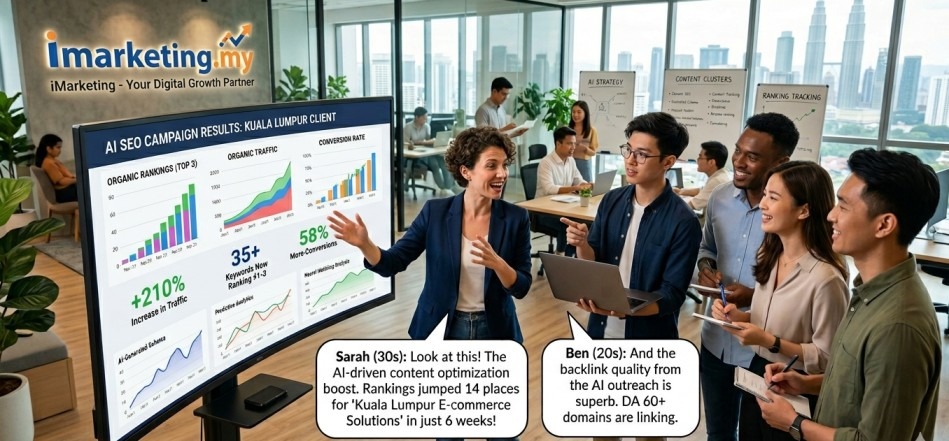
Consider a hypothetical B2B software company that partnered with an AI SEO company to improve its visibility in AI-generated search results. Prior to the engagement, the brand had decent traditional SEO metrics. Reasonable rankings, a solid backlink profile but almost no presence in ChatGPT responses or Google AI Overviews.
The AI SEO company restructured the brand’s content strategy around topical clusters, implemented comprehensive schema markup, and worked with internal subject-matter experts to produce in-depth guides that could be clearly attributed to named authors. Within several months, the brand began appearing in Google AI Overviews for key queries and was cited in ChatGPT responses for industry-specific questions.
What to Expect from AI Search in the Coming Years
The trajectory is clear: AI will play an ever-larger role in how people access information online. Predictive search, proactive content recommendations, and increasingly sophisticated entity recognition are all on the horizon.
For brands, this means the window for early-mover advantage is open but not indefinitely. As more companies adapt their SEO strategies for AI visibility, the competition for citations will intensify. The brands investing in this now will have a structural advantage that compounds over time.
AI models will also continue to evolve. What works today may need refinement tomorrow. Partnering with an AI SEO company that stays at the forefront of these developments rather than playing catch-up is one of the most pragmatic investments a brand can make.
Building Visibility That Survives the Next Shift
The brands that will thrive in AI-driven search aren’t necessarily the ones with the biggest budgets or the most backlinks. They’re the ones that have built genuine authority, structured their content intelligently, and positioned themselves as trustworthy sources in the eyes of both humans and machines.
Working with the right AI SEO company gives you a structured path to that position. From content strategy and structured data to E-E-A-T signals and AI citation optimisation, the work is nuanced—but the rewards are significant.
Search will keep evolving. The brands that treat AI visibility as a core marketing priority starting now are the ones that won’t have to scramble when the next shift arrives.