
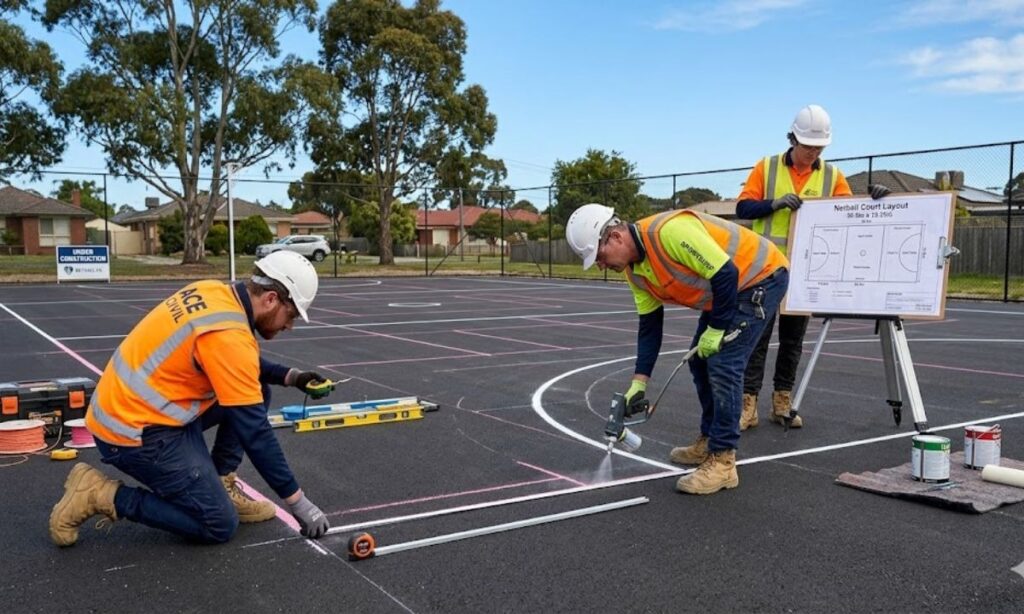
Netball is one of Australia’s most played sports, with over 1.2 million Australians taking to the court every year. Whether you’re a school, a club, or a homeowner wanting a backyard setup, building a netball court is a serious investment. Get it right and you have a safe, durable surface that lasts decades. Get it wrong and you’re looking at cracked bases, poor drainage, and costly repairs within a few years.
Before you break ground, there’s a lot to understand. From surface types and base construction to compliance standards and council approvals, every decision you make early on will affect the court’s long-term performance. This guide covers everything you need to know before you start.
Understanding Standard Netball Court Dimensions and Layout
A regulation netball court is 30.5 metres long and 15.25 metres wide. But the playing surface alone isn’t enough space. You also need clear run-off zones around the entire perimeter. These zones must be free of all obstacles, including fencing, seating, light towers, and drainage infrastructure. This is an International Netball Federation (INF) requirement put in place to protect both players and umpires, who officiate from outside the court boundaries.
Full-Size Court and Run-Off Zones
Netball Australia requires run-off zones on all four sides of the court. Unlike sports where officials stay on the sideline, netball umpires run around the outside of the playing area throughout the game. Any obstacle inside those run-off zones is a safety hazard. When you’re planning your site, you need to account for the full paved area, not just the court lines.
Half-Court and Multi-Sport Options
If space or budget is limited, a half-court layout is a practical option for residential builds. It costs less and takes less space, while still giving players a proper area to train. Multi-sport courts are also popular, especially in suburban areas where outdoor space is tight. You can include basketball, tennis, or pickleball line markings on the same surface without affecting the quality of the netball layout, as long as the markings are planned carefully and the surface grip is right for all sports.
Choosing the Right Surface for Australian Conditions
Surface choice is one of the most important decisions in the whole project. The wrong surface can wear out quickly, become slippery, or cause joint injuries over time. The right one will hold up against Australian heat, UV exposure, and heavy rainfall for many years.
When planning your surface, it’s worth talking to experienced netball court builders Australia who understand how different materials perform across different climates, from coastal humidity to inland heat.
Acrylic Surfaces
Acrylic is the most common surface for outdoor netball courts in Australia. It handles UV damage well, dries quickly after rain, and holds its colour and texture for years. It can also be adjusted for grip level, which matters for player safety. Acrylic systems are applied over a concrete or asphalt base and come in a range of colour options for line markings and court zones.
Concrete vs. Asphalt Base
The base your surface sits on matters just as much as the surface itself. Concrete is generally the better long-term choice. It is more stable, handles ground movement better, and has a longer predicted lifespan. Asphalt has a lower upfront cost, but it tends to develop structural cracks, depressions, and drainage issues within five years if the base preparation is not perfect. After 20 years, asphalt courts often need major restoration work. A court built on a properly designed concrete base will outlast an asphalt base in almost every scenario.
Cushioned Systems and Player Safety
For clubs and schools where players train regularly, a cushioned surface system is worth considering. These systems sit between the base and the top surface and reduce the impact on players’ joints during running, jumping, and landing. Advanced cushioned acrylics and prefabricated rubber mat systems are available, and they make a real difference for players who are on court for hours at a time.
Site Preparation and Base Construction
A well-built court starts long before the surface goes down. Site preparation is where most courts fail when corners are cut. Poor base construction leads to cracking, uneven settlement, and water pooling, all of which shorten the life of your court significantly.
Geotechnical Investigation
Before any base design is finalised, the site needs a geotechnical investigation. This involves testing the soil to understand its classification, load-bearing capacity, and how it will behave under a paved surface. The results directly influence the thickness and design of your base. Skipping this step is one of the most common mistakes on lower-budget builds, and it often leads to expensive repairs within a few years.
A feature survey of the site should also be carried out. This maps existing levels, trees, buildings, drainage paths, and any features that could affect the design. It gives your builder the information they need to plan earthworks and drainage accurately.
Drainage and Surface Gradient
Water management is critical for any outdoor court in Australia. The surface must have a gradient to allow water to run off quickly. Netball Australia and the INF specify that the surface gradient cannot exceed 1% in any direction. A diagonal grade is the preferred format. Drainage infrastructure like concrete spoon drains must be placed outside the run-off zones, not within them.
Compliance with Netball Australia and INF Standards
If your court will be used for competition, it must meet the standards set by Netball Australia and the International Netball Federation. These cover court dimensions, run-off zones, surface material, goal post specifications, and lighting requirements. Non-compliant courts may not be approved for official competition use by state and territory member organisations.
Goal posts must have a post diameter between 60mm and 100mm, with a vertical height of 3.05 metres. Round posts are preferred. Combined netball and basketball rings are not permitted for competition use, though they are acceptable for schools and casual play.
Key Add-Ons to Plan for
The court surface is just the starting point. Several supporting elements are essential to a functional, safe, and competition-ready facility.
Lighting
If the court will be used after dark, lighting needs to meet the Australian standard AS2560.2.4 as well as Netball Australia’s recommendations for the specific level of play. Lighting infrastructure must be installed outside the required run-off zones. It should also be designed to avoid light spill onto neighbouring properties. Getting lighting right from the start is far easier than retrofitting it later.
Fencing and Perimeter Infrastructure
Fencing defines the play area, improves safety, and prevents the ball from leaving the site. All fencing must sit outside the run-off zones. Retaining walls may also be required depending on the slope and layout of your site. These are load-bearing structures that need to be engineered correctly, not just built for appearance.
Line Markings and Goal Posts
Line markings should be applied with precision using durable, UV-resistant materials. Poorly marked courts cause confusion in play and wear out faster. If you are building a multi-sport court, each sport’s markings should use different colours so players can read the surface clearly. Goal posts should be installed to national and international standards, set in concrete footings, and checked for stability before the court is used.
How Long Does It Take and What Does It Cost?
Most new netball court builds take between four and eight weeks from start to finish. This covers site preparation, base construction, surfacing, line marking, and equipment installation. Resurfacing an existing court is faster, often one to two weeks, depending on weather and site access.
Cost varies depending on several factors: the size of the court, the surface type you choose, the condition of the site, and any extras like lighting, fencing, or multi-sport markings. A half-court is generally more affordable than a full-size build. Resurfacing costs less than a full new build. Getting a fixed-price quote that details every stage of the project before work begins protects you from unexpected costs later.
Questions to Ask Before You Hire a Court Builder
Not all builders are equal. Before you sign anything, ask the right questions.
Is the builder licensed? In Queensland, for example, builders should hold a current QBCC licence. Check what states require for licensed construction in your area.
What warranty do they offer? A reputable builder should provide at least a five-year warranty on both workmanship and materials. Some surface systems carry separate manufacturer warranties of up to 15 years.
Do they provide a fixed-price quote? A detailed, itemised quote protects you. Vague quotes leave room for cost blowouts.
Have they done courts in similar conditions to yours? Experience with coastal, inland, or high-rainfall environments matters. Ask to see completed projects and speak to previous clients if possible.
Final Thoughts
Building a netball court in Australia is a significant but rewarding project. Done properly, it gives players a safe and consistent surface for years to come. Done poorly, it becomes an ongoing maintenance headache. Plan your site carefully, choose the right surface for your climate, get the base right, and work with a licensed builder who knows the Netball Australia and INF requirements. The time you spend planning now will save you a lot of money and frustration down the track.