
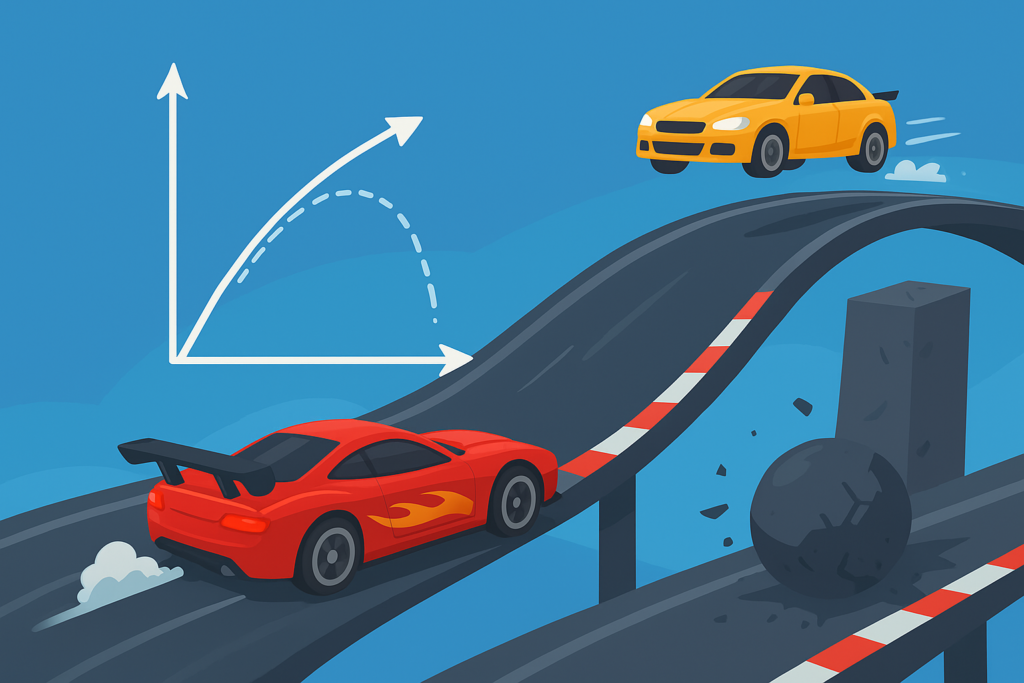
If you have ever tried to code a racing game from scratch, you know the headache of getting the vehicle dynamics right. It isn’t just about making a car move forward; it’s about tire grip, suspension travel, weight transfer during a drift, and how the chassis reacts to a jump.
For indie game developers, these mathematical hurdles often turn a fun creative project into a months-long physics lesson. You spend more time tweaking friction coefficients than actually designing fun tracks. This is where modern development tools are changing the workflow. AI can now assist in handling these heavy calculations, allowing you to define how you want the car to feel without needing a PhD in mechanical engineering.
Mastering Vehicle Evolution and Mechanics
One of the trickiest parts of racing game physics is handling how a vehicle changes over time. In many arcade racers, cars aren’t static objects; they upgrade, evolve, or even completely transform during a race. When a vehicle changes shape or gains new parts, its center of mass and handling characteristics need to update instantly to match the new visual form.
Programming this manually requires complex state machines that swap out physics profiles on the fly. If the transition isn’t smooth, the car might clip through the floor or launch into the stratosphere. AI-assisted game development tools can help automate these transitions by predicting the new mass and drag values based on the vehicle’s new components.
For a great example of how mechanics adapt when vehicles change properties, check out Evolution Merge.
In this context, the physics engine isn’t just calculating movement; it’s reacting to the player’s progression. As the vehicle “merges” or upgrades, the handling feels heavier or faster, giving the player immediate tactile feedback. This is crucial for keeping the gameplay loop satisfying. If a massive truck handles exactly like a go-kart, the visual upgrade feels meaningless.
Handling Momentum and Gravity
Verticality adds a whole new layer of complexity to racing game physics. When you introduce ramps, loops, and massive drops, you aren’t just dealing with friction anymore—you are fighting gravity simulation.
The challenge is maintaining speed on slopes and ensuring trajectory calculations feel fair. If a car hits a ramp at 100 mph, it needs to arc through the air predictably. Too much “floatiness” and it feels like a moon landing; too much gravity and it feels like a brick. AI tools can assist by running simulations to find the “sweet spot” for these values, ensuring that jumps feel thrilling rather than frustrating.
To see high-speed vertical gameplay and momentum in action, take a look at Vertical Rush. In this example, momentum is key. The physics system has to account for the vehicle maintaining incredible speed while navigating steep inclines. This requires precise tuning of drag and downward force. Using AI game Creation tools, developers can test thousands of jump variations to ensure the car lands on the track every time, rather than manually adjusting the gravity constant for every single ramp.
Environmental Interaction and Collision
A racing game feels dead if the world doesn’t react to the car. Whether it is smashing through a barrier or digging through terrain, collision detection is vital for immersion. However, destructible environments are a nightmare for physics engines.
You have to determine what breaks, how much force it takes to break it, and what happens to the car’s momentum afterward. If you hit a concrete wall, you should stop. If you hit a wooden fence, you should smash through with a slight loss of speed. AI can help define these material properties and interaction rules, creating a matrix of logic that determines how the vehicle interacts with every object in the scene. For a demonstration of environmental interaction where vehicles must dig and navigate obstacles, play Block Miner.
Here, the vehicle isn’t just racing on top of a surface; it is interacting with the volume of the terrain. This requires a different approach to collision detection, often using voxel-based logic or dynamic mesh updates. Astrocade and similar platforms simplify this by providing pre-built behaviors for digging and crashing, so you don’t have to write the collision resolution code from scratch.
Start Building Your Physics-Based Project
The barrier to entry for creating complex vehicle simulations has never been lower. By leveraging AI tools, you can bypass the most frustrating parts of physics programming—like debugging math equations or fine-tuning suspension dampening—and focus entirely on the gameplay loop.
Studying existing games is the best way to understand how these mechanics come together. Look at how they handle weight, jumps, and crashes, and use those insights to inform your own designs. You don’t need to be a math wizard to build a great racing game anymore; you just need the right tools and a clear vision of how you want your drive to feel.