
Mobile internet has become an essential part of everyday life in the Philippines. People use smartphones for messaging, social media, video calls, online classes, banking, streaming, gaming, shopping, navigation, and work. As mobile networks continue to develop, one question comes up frequently: What is the actual difference between 4G and 5G?
The arrival of 5G has introduced faster wireless connectivity and improved network capabilities, but that does not necessarily mean every smartphone user will experience a dramatic improvement simply by switching to a 5G-compatible device.
Your location, phone, network provider, coverage, network congestion, and the activity you are performing all affect the experience.
Understanding the difference between 4G and 5G can help Filipino consumers decide whether upgrading their device or changing their mobile plan is worthwhile.
What Is 4G?
4G stands for the fourth generation of mobile network technology. It replaced older generations and brought a significant improvement in mobile internet performance.
For many Filipinos, 4G LTE has become the standard mobile connection for everyday smartphone use.
A good 4G connection is generally capable of handling activities such as:
- Browsing websites
- Using social media
- Streaming music
- Watching videos
- Video calling
- Online shopping
- Using navigation apps
- Playing many online games
- Sending large files
- Using cloud-based applications
The exact speed a user experiences depends on the network, device, location, signal conditions, and network traffic.
4G is therefore still highly useful even as 5G networks expand.
What Is 5G?
5G is the fifth generation of mobile network technology. It was designed to improve wireless connectivity in several areas, including speed, responsiveness, capacity, and the ability to connect large numbers of devices.
One of the biggest advantages of 5G is its potential for significantly faster data transmission than older mobile technologies.
However, the word potential is important.
A 5G icon on your phone does not automatically mean that you will receive maximum 5G performance. Actual results vary according to coverage, spectrum, network design, device capabilities, and congestion.
This is why someone standing in an area with excellent 4G coverage may sometimes have a better experience than someone connected to a weak 5G signal.
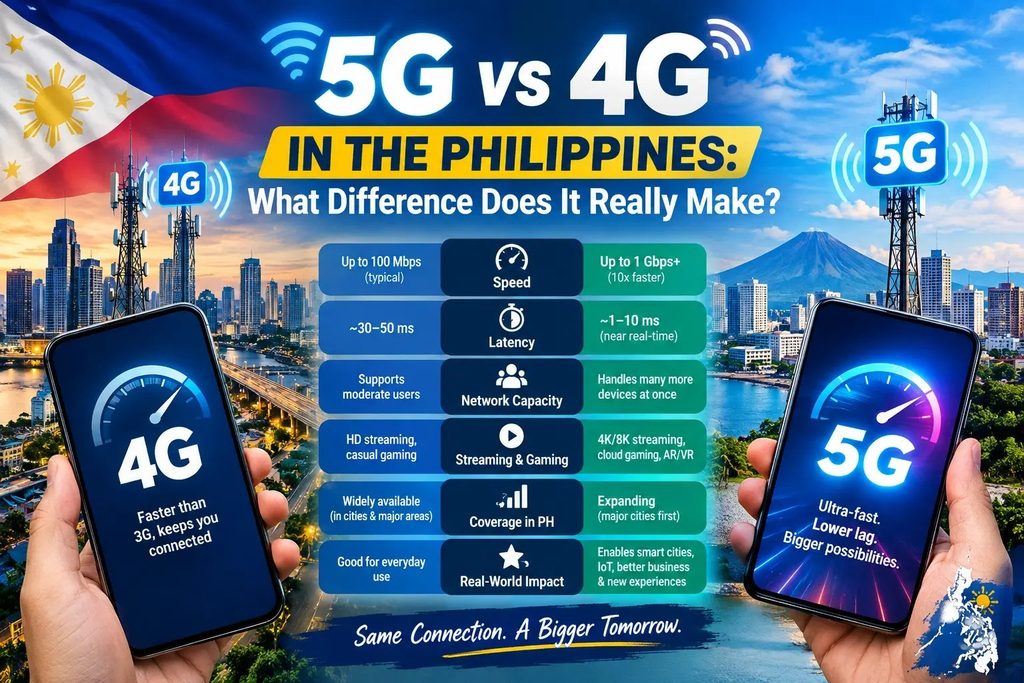
5G vs. 4G: The Main Differences
The easiest way to understand the two technologies is to look at the areas where 5G is designed to improve on 4G.
1. Speed
Speed is probably the most noticeable difference.
5G networks can support much higher data speeds than 4G under suitable conditions. This can make large downloads faster and high-quality streaming more responsive.
For everyday tasks such as checking email or sending messages, however, the difference may not always be obvious.
If a webpage loads quickly enough on 4G, upgrading to 5G may not dramatically change the experience.
2. Latency
Latency refers to the delay between sending a request and receiving a response from the network.
Lower latency can be particularly useful for applications that require quick communication between a device and a server.
This can matter for:
- Online gaming
- Video conferencing
- Interactive cloud applications
- Remote control systems
- Real-time collaboration
- Other responsive applications
For someone who primarily uses mobile data for browsing and messaging, latency improvements may be less noticeable.
For gamers or people using interactive applications, however, responsiveness can be more important than raw download speed.
3. Network Capacity
5G is also designed to handle large numbers of connected devices more efficiently.
This matters in densely populated locations such as business districts, shopping centers, transport hubs, campuses, and large events.
When many people connect to a network simultaneously, congestion can affect performance. A network with greater capacity can potentially manage heavy traffic more effectively.
That does not mean 5G is immune to congestion. Any wireless network can become busy when demand is high.
4. Device Compatibility
A smartphone must support the relevant 5G technology and frequency bands to use a 5G network.
Having a 5G-capable phone is therefore only one part of the equation.
Users also need:
- A compatible mobile plan or service.
- 5G coverage in their location.
- A device compatible with the network’s supported bands.
- Suitable signal conditions.
Without these factors, a 5G phone may continue using 4G.
Does 5G Always Mean Faster Internet?
No.
This is one of the biggest misconceptions about 5G.
The technology is capable of much higher performance, but real-world speed depends on several variables.
For example, a user might experience slower-than-expected 5G because of:
- Weak signal
- Network congestion
- Indoor coverage limitations
- Distance from a cell site
- Device limitations
- Supported frequency bands
- Temporary network conditions
- Local infrastructure
Meanwhile, a strong 4G connection can provide excellent performance.
The best network is therefore not always the one with the newest technology. The quality of the connection in your specific location matters more.
How 5G and 4G Affect Video Streaming
Streaming video is one area where faster mobile connectivity can be useful.
Higher speeds can make it easier to stream high-resolution content and download videos for offline viewing.
However, most users do not need extremely high speeds simply to watch ordinary video.
If a strong 4G connection already allows smooth streaming without buffering, the practical benefit of 5G may be relatively small.
The advantage becomes more apparent when several demanding activities are happening simultaneously or when downloading large files.
5G vs. 4G for Online Gaming
Gaming is another area where the differences can become interesting.
Many online games do not require enormous download speeds. Instead, latency, stability, and consistency can have a major effect on the gaming experience.
A fast but unstable connection can be frustrating.
A stable connection with relatively low latency may provide a better experience even if its maximum download speed is lower.
This distinction is useful for mobile gamers who use entertainment platforms and online gaming services, including users searching for services such as TMT Cash.
For gaming-related browsing, account access, and other online activities, both 4G and 5G can be perfectly usable when the connection is stable.
The technology generation alone does not determine whether a gaming session will be smooth.
5G vs. 4G for Online Casinos and Digital Entertainment
Digital entertainment can also benefit from reliable mobile connectivity.
People may access gaming platforms, watch live content, communicate with other users, or manage accounts through smartphones.
A service such as TMT Cash Casino, for example, may be accessed through a mobile device depending on the platform’s available services and the user’s connection.
For these activities, reliability can be just as important as speed.
A user with a stable 4G connection may have a better experience than someone with an inconsistent 5G signal.
The practical goal should therefore be a reliable connection that matches the activity, rather than simply choosing the newest network label.
5G vs. 4G for Video Calls
Video conferencing has become common for work, school, and personal communication.
A reliable connection is essential because video calls involve continuous two-way data transmission.
5G can provide greater capacity and lower latency under suitable conditions, potentially improving responsiveness.
However, a strong 4G connection can already support many ordinary video calls.
If a user regularly experiences freezing video, audio delays, or dropped calls, the problem may not necessarily be the absence of 5G. Network congestion, signal quality, device performance, or the video application’s requirements could also be responsible.
Why Location Matters So Much in the Philippines
The Philippines presents unique challenges for mobile connectivity because users live and work in very different environments.
A network experience in a dense urban district can be very different from one in a rural community.
Buildings can also affect signal quality. Concrete walls, underground areas, elevators, and other physical barriers may weaken wireless signals.
Weather and environmental conditions can also influence infrastructure and connectivity in certain circumstances.
This is why network comparisons should always be considered alongside location.
Instead of asking only, “Is 5G better than 4G?”, a more useful question is:
“Which network provides the most reliable service where I actually use my phone?”
Should You Upgrade to a 5G Phone?
Whether upgrading makes sense depends on your needs.
A 5G phone may be worthwhile if:
- You regularly use mobile data.
- 5G coverage is strong where you live or work.
- You download large files frequently.
- You stream high-quality video.
- You use demanding cloud applications.
- You play latency-sensitive online games.
- You want a device that will remain relevant as networks develop.
On the other hand, upgrading may not be necessary if:
- You primarily use Wi-Fi.
- Your current 4G connection is reliable.
- You mostly send messages and browse websites.
- 5G coverage is limited in your area.
- Your current smartphone still meets your needs.
A technology upgrade should solve a real problem rather than simply provide a newer specification.
How to Get Better Mobile Internet Performance
Whether you use 4G or 5G, several practical steps can improve your experience.
Check Your Location
Move closer to a window or open area if your indoor signal is weak.
Keep Your Phone Updated
Software and carrier updates can improve compatibility, stability, and network performance.
Check Network Settings
Make sure your phone is configured to use the appropriate network mode.
Monitor Data Usage
Some applications can consume substantial amounts of data in the background.
Avoid Congested Locations When Possible
If performance drops in crowded areas, network congestion may be responsible.
Compare Real-World Coverage
Before switching providers, consider coverage where you actually spend time rather than relying only on nationwide claims.
4G Is Not Obsolete
The arrival of 5G does not make 4G useless.
In fact, 4G remains an important part of mobile connectivity. Many devices and locations continue to rely on it, and users can still accomplish most everyday smartphone activities with a good 4G connection.
The transition to newer network technologies is gradual.
For consumers, the practical question is not whether 4G is “old” and 5G is “new.” It is whether the available network provides the speed, reliability, coverage, and responsiveness needed for their activities.
Frequently Asked Questions
Is 5G better than 4G in the Philippines?
5G can offer higher speeds, lower latency, and greater capacity than 4G under suitable conditions. However, actual performance depends on coverage, location, device compatibility, network congestion, and signal quality.
Is 4G still good enough?
Yes. A strong 4G connection is sufficient for many common activities, including browsing, messaging, streaming, video calls, social media, and many online games.
Does a 5G phone automatically use 5G?
No. A 5G-compatible phone needs access to a compatible 5G network and suitable coverage. Otherwise, it may connect through 4G or another available network technology.
Is 5G better for gaming?
It can be, particularly when the network provides low latency and stable performance. However, connection consistency is often more important than maximum download speed.
Why is my 5G connection sometimes slower than 4G?
Possible reasons include weak 5G coverage, network congestion, indoor signal limitations, device compatibility, or local network conditions.
Do I need 5G for streaming?
Not necessarily. A good 4G connection can support many streaming activities. 5G becomes more useful when higher-resolution content, faster downloads, or multiple demanding activities require additional capacity.
Final Thoughts
The difference between 4G and 5G is more complicated than simply saying that one is faster.
5G was designed to provide greater speeds, lower latency, and increased network capacity. These improvements can make a noticeable difference for demanding applications, crowded locations, high-quality streaming, cloud services, and certain gaming experiences.
But 4G remains highly capable.
For Filipino smartphone users, coverage and reliability should be considered alongside technology generation. A strong 4G connection can be more useful than a weak 5G signal, particularly for everyday activities that do not require extreme speeds.
As 5G coverage continues to develop, more users will have the opportunity to experience its advantages. Until then, choosing the right connection means looking beyond the 4G or 5G icon and considering what you actually do online, where you use your phone, and how consistently your network performs.
In other words, the best mobile connection is not necessarily the newest one. It is the one that reliably keeps you connected when you need it.